CPC vs CPM: What Is the Difference and Which Is Better for Your Ads?
Published: 22 Nov 2026
Hey guys! Running online ads is not just about creating a good image or writing an attractive message. You need to decide how you will pay for those ads and what results you expect from your spending.
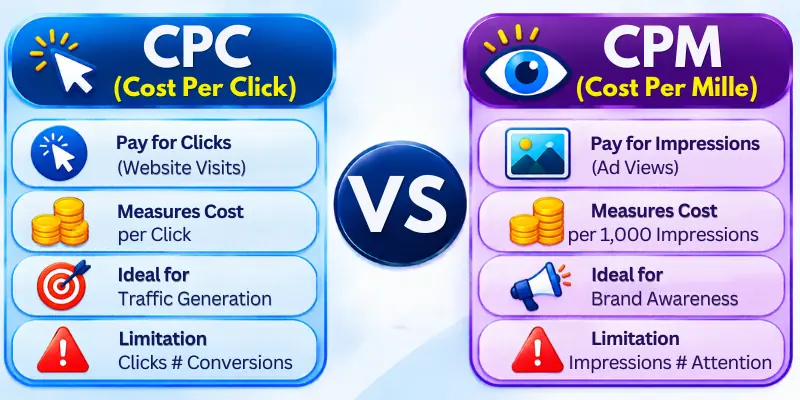
Two common pricing models are CPC and CPM. You will often come across these terms when working with online advertising platforms. Although both help businesses manage their ad spending, they measure different things. CPC is connected to clicks, while CPM is based on impressions.
In this guide, we will break down CPC vs CPM with simple examples. We will compare their costs, explain how to calculate them, and discuss the situations where each one makes sense. By the end, you will have a clearer idea of which option fits your advertising plan.
What Is CPC (Cost Per Click)?
CPC stands for Cost Per Click. It is an advertising pricing model where you pay when someone clicks your advertisement.
For example, suppose you own an online store that sells mobile phones. You create an ad for a new phone and show it to people who may be interested in buying one. Some people scroll past it, while others click to visit your product page.
Under a CPC pricing model, the clicks are used to calculate your advertising cost. The number of people who only see the ad does not directly determine that cost.
This model is useful when you want to bring visitors to a particular page. It gives you a clear way to measure how much you spend to attract clicks. You can then study what those visitors do after reaching your website.
What Is CPM (Cost Per Mille)?
CPM stands for Cost Per Mille, which means Cost Per Thousand Impressions. The word “Mille” means one thousand. This pricing method tells you how much you pay for every 1,000 times your advertisement is shown.
Let’s understand it with an example. Imagine you own a small shoe business and want more people to recognize your brand. You create an attractive ad and show it to your target audience. With CPM pricing, your advertising cost is based on the number of impressions your ad receives.
An impression means one time your advertisement appears. It does not mean that a person clicked, purchased something, or even visited your website. The same person may see your advertisement more than once, and each appearance can count as another impression.
Businesses often use CPM when their main goal is to increase brand awareness and get their advertisements in front of more people.
CPC vs CPM Comparison Table
Now that we have covered both pricing models, let’s put their main details side by side. This table gives you a quick way to check how they differ:
| Point | CPC | CPM |
| Full Form | Cost Per Click | Cost Per Mille |
| Payment Basis | Clicks | Impressions |
| Measurement | Average cost per click | Cost per 1,000 impressions |
| Main Metric | CPC | CPM |
| Common Campaign Focus | Website traffic | Ad exposure |
| User Action Required | A click is needed for a click charge | No click is needed for an impression |
| Formula | Total Cost ÷ Clicks | (Total Cost ÷ Impressions) × 1,000 |
| Useful For | Traffic-focused campaigns | Awareness-focused campaigns |
| Performance Questions | How much did each click cost? | How much did 1,000 impressions cost? |
| Main Limitation | Clicks do not guarantee conversions | Impressions do not guarantee attention or action |
Keep in mind: These models measure different parts of an advertising campaign. Their costs should not be compared as if they were the same unit.
Difference Between CPC and CPM
CPC and CPM differ in more ways than just how advertisers pay. The following points will help you compare their costs, delivery, and performance.
Here are the 10 main differences:
- Payment Structure
- Budget Planning
- Campaign Objectives
- Audience Reach
- User Interaction
- Click-Through Rate (CTR)
- Conversion Tracking
- Cost Predictability
- Ad Visibility
- Performance Measurement
Now, let’s look at each difference more closely.
1. Payment Structure
The first difference is when an advertising platform charges you for your ad activity.
CPC:
- You are charged when someone clicks your advertisement.
- Views without clicks do not create a CPC charge.
- Your total cost depends on the number of billable clicks.
CPM:
- You are charged based on the impressions delivered.
- A click is not required for an impression to count.
- Your cost is linked to the number of impressions, usually measured in groups of 1,000.
2. Budget Planning
Both models need careful budget planning, but you estimate spending in different ways.
CPC:
- You can estimate your budget by setting a target number of clicks.
- A higher number of clicks can increase your total spending.
- You need to consider how much you are willing to pay for each visitor.
CPM:
- You can estimate your budget based on the number of impressions you want.
- Your planned spending is linked to the expected ad exposure.
- You can use your target impression volume to estimate the campaign budget.
3. Campaign Objectives
The purpose of your campaign can help you decide which pricing model to use.
CPC:
- Works well when your campaign needs people to visit a website or landing page.
- Can support campaigns that encourage users to explore products or services.
- Gives you a way to measure the cost of attracting visitors.
CPM:
- Can support campaigns that focus on showing an advertisement to a selected audience.
- Suits campaigns where repeated exposure to a brand or message matters.
- Helps advertisers plan the cost of delivering a certain number of impressions.
4. Audience Reach
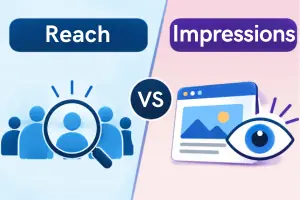
Reach and clicks are different. One measures how many people see your ad, while the other measures how many people interact with it by clicking.
CPC:
- The pricing model focuses on clicks rather than the number of different people reached.
- You may receive clicks from a smaller or larger audience.
- You need separate reach data to understand how many unique people saw your ad.
CPM:
- Helps you plan and measure the cost of delivering impressions to an audience.
- You can review reach reports to understand how many different people saw your ad.
- Repeated impressions from the same person can increase the impression count without increasing unique reach.
5. User Interaction
The two models treat user interaction differently when calculating advertising costs.
CPC:
- A click is the action that creates a charge.
- People who only view the ad do not create a click charge.
- You can compare the number of clicks with other actions users take after visiting your website.
CPM:
- A click is not needed for the platform to count an impression.
- People may see the ad without taking any further action.
- You pay for eligible impressions even when users do not click.
6. Click-Through Rate (CTR)
CTR helps you understand how often people click after an advertisement is shown. However, it plays a different role when reviewing CPC and CPM campaigns.
CPC:
- CTR can help explain how effectively your ad turns impressions into clicks.
- A higher CTR may help you receive more clicks from the same number of impressions.
- You should review CTR along with average CPC to understand your click performance.
CPM:
- CTR shows whether impressions are leading to clicks, even though clicks are not required for the CPM charge.
- A low CTR does not automatically mean the campaign failed if its main goal is exposure.
- You can use CTR to see whether your ad is encouraging additional interaction.
7. Conversion Tracking
Clicks and impressions do not tell you how many people completed a useful action. Conversion tracking helps you measure what happens after someone interacts with your advertisement.
CPC:
- You can track how many people who clicked your ad completed a purchase, signup, or inquiry.
- It helps you compare the cost of attracting visitors with the results they produce.
- A large number of clicks does not guarantee a high number of conversions.
CPM:
- You can track conversions from people who were exposed to your advertisement, depending on the platform’s attribution settings.
- It helps you study whether an exposure-focused campaign contributes to later actions.
- You may need additional reports to understand the connection between impressions and conversions.
8. Cost Predictability
Both models allow you to estimate costs, but the final amount can change as your campaign runs.
CPC:
- Your total spending depends on the number of billable clicks and their actual costs.
- Click volume can be difficult to predict before the campaign starts.
- You should monitor your average CPC and click volume to keep spending under control.
CPM:
- You can estimate spending using your expected number of impressions and CPM rate.
- Your final cost can change if the actual CPM or delivered impressions differ from your estimate.
- It may be easier to plan a budget around a target impression volume.
9. Ad Visibility
Ad visibility is about whether an advertisement has a chance to be seen by users. An impression does not always mean that someone noticed or viewed the ad.
CPC:
- The pricing model does not charge you simply because your ad receives an impression.
- You need to review impression and viewability reports separately to understand ad exposure.
- A click shows that someone interacted with the ad, but it does not explain how many people saw it without clicking.
CPM:
- Charges are linked to impressions rather than clicks.
- Standard impressions do not always mean the ad was visible on the user’s screen.
- Viewable impression reports can give you more information about whether ads appeared in a viewable position.
10. Performance Measurement
The final difference is how you review the results and decide whether your campaign is meeting its goal.
CPC:
- Average CPC helps you review the cost of attracting each click.
- CTR helps you understand how often impressions lead to clicks.
- Conversion rate and cost per conversion help you study the value of the traffic.
CPM:
- CPM helps you review the cost of delivering 1,000 impressions.
- Reach and frequency help you understand audience exposure.
- Viewability and engagement metrics can provide more detail about how people respond to your ads.
Remember, neither model is successful just because its cost is low. Always compare the results with the goal you set before launching the campaign.
When Should You Choose CPC?
CPC is a suitable choice when your main goal is to attract visitors and encourage them to take action on your website. Consider using it in these situations:
- Website Traffic: When you want more people to visit your website, blog, or landing page.
- Online Stores: When you want potential customers to explore product pages and check prices.
- Lead Generation: When you want visitors to fill out a form, request a quote, or contact your business.
- Service Promotion: When you want people to learn about your services and visit your service pages.
- Special Offers: When you want to bring interested users to a page that explains a discount or limited-time deal.
- Content Promotion: When your goal is to attract readers to articles, guides, or other useful content.
- Conversion-Focused Campaigns: When you want to attract visitors and track how many complete a desired action after clicking.
When Should You Choose CPM?
CPM is a good choice when your main goal is to show your advertisement to more people and increase brand exposure. Consider using it in these situations:
- Brand Awareness: When you want more people to recognize your business and become familiar with your brand.
- New Product Launches: When you want to introduce a new product to your target audience.
- Event Promotion: When you want to spread information about an upcoming event, exhibition, or conference.
- Seasonal Campaigns: When you want to show holiday offers, seasonal deals, or special promotions to a wider audience.
- Product Awareness: When you want people to learn about a product before making a purchase.
- Video Advertising: When your goal is to show video ads and increase exposure to your message.
- Large-Scale Campaigns: When you want to deliver your advertisement across different websites, apps, or placements to reach your target audience.
Can You Use CPC and CPM Together?
Yes, you can use CPC and CPM as part of the same advertising strategy. Each model can serve a different purpose at different stages of your campaign.
For example, an online shoe store can use CPM to introduce a new collection to its target audience. Once people become familiar with the collection, the store can use CPC to bring interested users to its product pages.
You can follow this simple approach:
- Build Brand Awareness: Start with a CPM campaign to show your products or services to your target audience.
- Attract Website Visitors: Use a CPC campaign to bring interested people to your website or landing page.
- Track Campaign Results: Review impressions, reach, clicks, and conversions to understand how each campaign performs.
- Improve Your Strategy: Adjust your audience, ad message, and budget based on the results.
Using both models allows you to work on brand exposure and website traffic without expecting one campaign to achieve every goal. The key is to give each campaign a clear purpose and measure its results separately.
Final Words
In this guide, we have covered the difference between cpc and cpm, including their meanings, formulas, payment methods, and key differences. We have also discussed campaign goals, cost factors, and how businesses can use both models as part of one advertising plan.
Personally, I prefer CPC for website traffic and CPM for brand awareness. The right choice depends on your campaign goal and the results you want.
Keep these tips in mind before starting your campaign:
- Set a Goal: Know what you want to achieve.
- Choose Your Audience: Target the right people.
- Check Your Ad: Use a clear message and relevant landing page.
- Track Results: Monitor the metrics that matter.
- Test and Improve: Review your results and adjust your strategy.
Before you leave, check the FAQs below for quick answers to common questions about CPC and CPM.
FAQs
Here are some useful answers to common CPM vs CPC questions:
1. What is the main difference between CPC and CPM?
CPC stands for Cost Per Click, while CPM stands for Cost Per Mille. CPC measures how much you pay for each click on your advertisement. CPM measures how much you pay for every 1,000 impressions. Both are advertising pricing models, but they measure different results.
2. Is CPC better than CPM?
Neither option is better in every situation. CPC may be more suitable when you want people to visit your website, explore a product, or complete another action after clicking an ad.
CPM may be more useful when your main purpose is to introduce a brand or increase the exposure of an advertisement. Choose the model that matches your campaign objective.
3. What does CPM stand for in digital marketing?
CPM stands for Cost Per Mille. “Mille” is a Latin word that means one thousand. In digital advertising, CPM represents the cost of 1,000 impressions. It is often used in campaigns that focus on showing advertisements to an audience.
4. How do you calculate CPC?
Divide your total advertising cost by the number of clicks your campaign receives.
Formula:
CPC = Total Advertising Cost ÷ Total Clicks
For example, if you spend $100 and receive 200 clicks:
CPC = $100 ÷ 200
Average CPC = $0.50
This means each click costs an average of 50 cents.
5. How do you calculate CPM?
Divide your total advertising cost by the total impressions, then multiply the result by 1,000.
Formula:
CPM = (Total Advertising Cost ÷ Total Impressions) × 1,000
For example, if you spend $200 and receive 50,000 impressions:
CPM = ($200 ÷ 50,000) × 1,000
CPM = $4
Your cost is $4 for every 1,000 impressions.
6. Can I use CPC and CPM on the same advertising platform?
Yes. Some advertising platforms offer both CPC and CPM bidding options. The available choices depend on the platform, campaign objective, ad format, and placement.
You should check the bidding options available when creating your campaign. Also, remember that the platform may use different auction and delivery rules for each option.
7. Does a low CPC mean my campaign is successful?
Not necessarily. A low CPC means you are paying less for each click, but it does not prove that your campaign is bringing sales or leads.
For example, your advertisement may receive 1,000 clicks, but only five visitors may complete a purchase. You should review your conversion rate, cost per conversion, and return on ad spend to understand the actual value of those clicks.
8. Do impressions count when nobody clicks an advertisement?
Yes. An impression can count when an advertisement is displayed, even if the person does not click it.
For example, if your ad receives 10,000 impressions and 200 clicks, all 10,000 impressions are included when calculating CPM. The 200 clicks are used to calculate CPC.
9. Which advertising model should a small business use?
Start by deciding what your business needs most. If you want people to visit your online store, service page, or contact form, CPC may be worth testing. If you are introducing a new business and want more people to see your brand, CPM may be a better starting point.
You should test your campaign with a manageable budget and review the results. This will help you understand which approach works better for your audience.
10. What is the relationship between CPC, CPM, and CTR?
These three metrics help you understand different parts of an advertising campaign.
- CPC: Measures the average cost of each click.
- CPM: Measures the cost of 1,000 impressions.
- CTR: Measures the percentage of impressions that result in clicks.
For example, suppose your ad receives 10,000 impressions and 200 clicks. Your CTR is 2%.
You can use all three metrics together to understand how much you are spending, how often people see your advertisement, and how often they click it.



- Be Respectful
- Stay Relevant
- Stay Positive
- True Feedback
- Encourage Discussion
- Avoid Spamming
- No Fake News
- Don't Copy-Paste
- No Personal Attacks
- Be Respectful
- Stay Relevant
- Stay Positive
- True Feedback
- Encourage Discussion
- Avoid Spamming
- No Fake News
- Don't Copy-Paste
- No Personal Attacks
