Reach vs Impressions – What Is the Difference & Which Matters More?
Published: 21 Nov 2026
Hey guys! Have you ever checked your social media insights and wondered why your impressions are higher than your reach? Or maybe you have seen these two numbers in your reports but still don’t know what they mean. Don’t worry! You are not alone.
Many people think impressions and reach mean the same thing. However, they measure two different things. One tells you how many times people saw your content, while the other tells you how many different accounts saw it.
In this article, we will explore reach vs impressions in simple words. We will understand what each metric means, how it works, and why both matter. I will also share easy examples, explain their key differences, and help you understand which metric you should track for your social media goals.
Let’s start with the basics!
What Are Impressions?
Impressions refer to the total number of times your content appears on someone’s screen. This number can include repeat displays to the same person.
For example, imagine you publish a Facebook post. One person sees it in the morning and then sees it again in the evening. These two displays can count as two impressions. If 100 people see your post twice, you may get 200 impressions.
You can use this metric to understand how often your content appears in front of your audience. It can help you check content visibility and see how often people come across your posts or ads.
For example:
- 50 people see your post once.
- 30 people see it two times.
- 20 people see it three times.
Your total impressions will be 170.
You can use impressions to understand how often your content gets displayed, even when the same people see it more than once.
What Is Reach?
Reach refers to the number of unique accounts that see your content at least once. It does not count the same account again when it sees your content multiple times during the reporting period.
For example, imagine you publish an Instagram post. Ten different accounts see it. Some of them view it again later, but the platform still counts each account only once for reach.
This means your post can have 10 reach and 25 impressions. The 10 represents the unique accounts that saw it, while the 25 represents the total number of times it appeared.
Reach helps you understand how many different accounts your content reaches. It is useful when you want to grow your audience, introduce your brand to new people, or check how widely your posts spread.
For example:
- 40 different people see your post.
- 15 of them see it again.
- 5 of them see it three times in total.
Your reach will be 40 because only 40 unique accounts saw the post.
You can use this metric to check how many different people or accounts your content reaches.
Impressions vs Reach: Quick Comparison
Now that we understand both terms, let’s compare them side by side. This table will make their differences easier to understand.
| Comparison Point | Impressions | Reach |
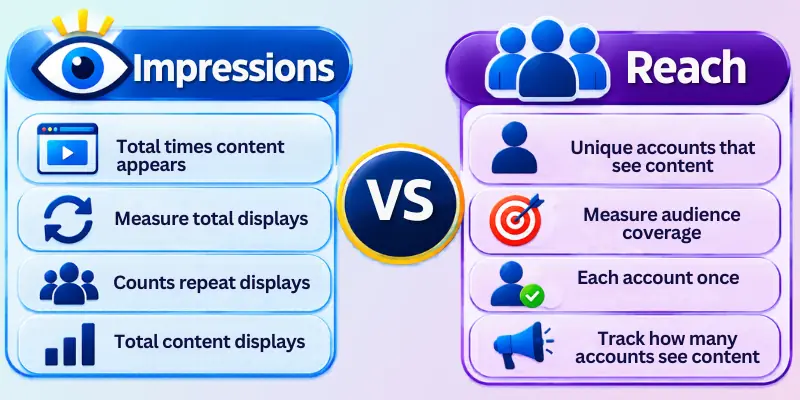
| Meaning | Total times content appears | Unique accounts that see content |
| Main Goal | Measure total displays | Measure audience coverage |
| Repeat Views | Counts repeat displays | Counts each account once |
| Measurement | Total content displays | Unique accounts |
| Audience | Can count the same account multiple times | Counts each account once |
| Main Use | Track total content exposure | Track how many accounts see content |
| Best For | Understanding repeated exposure | Understanding audience size |
| Typical Result | Usually equal to or higher than reach | Usually equal to or lower than impressions |
Remember: Impressions count how many times people see your content, while reach counts how many different accounts see it.
Difference Between Reach and Impressions
Both metrics help you understand your social media performance. However, they answer different questions. Impressions focus on total content displays, while reach focuses on unique accounts.
Here are 10 important differences you should know:
- Measurement
- Repeated Views
- Average Frequency
- Audience Coverage
- Organic vs Paid Results
- Advertising Costs
- Marketing Goals
- Platform Reporting
- Performance Analysis
- Measurement Limitations
Let’s understand each difference with simple examples.
1. Measurement
The first difference is the basic unit each metric measures. One counts content displays, while the other counts unique accounts.
Impressions:
- Count the total number of times your content appears.
- Include multiple counted displays to the same account.
- Increase when the platform records another impression.
Reach:
- Counts the unique accounts that see your content.
- Counts each account once within the reporting period.
- Does not increase when an already-counted account sees the content again.
2. Repeated Views
Repeated displays can change your impression count without changing your reach. This is one of the easiest ways to understand the difference.
Impressions:
Imagine Sarah sees your Facebook post three times during the day. If the platform counts all three displays, they add three impressions.
Reach:
The same three displays still count as one reached account because Sarah is only one unique account.
3. Average Frequency
Average frequency shows how many times, on average, each reached account saw your content. You can calculate it by dividing impressions by reach.
Impressions:
- Provide the total number of displays.
- Supply the number you need to calculate average frequency.
- Help show how much repeated exposure your content received.
Reach:
- Provides the number of unique accounts.
- Shows how many accounts received the exposure.
- Supplies the second number in the average frequency formula.
Formula:
Average Frequency = Total Impressions ÷ Total Reach
Example:
Suppose your post receives:
- Impressions: 3,000
- Reach: 1,000
Your average frequency will be:
3,000 ÷ 1,000 = 3
This means each reached account saw your content an average of three times.
4. Audience Coverage
Reach gives you a clearer idea of how many different accounts saw your content. Impressions do not tell you the number of unique accounts on their own.
Impressions:
- Show the total number of content displays.
- Can include several displays to the same account.
- Do not tell you exactly how many unique accounts saw your post.
Reach:
- Shows the number of unique accounts exposed to your content.
- Helps you understand the size of the audience that saw your post.
- Makes it easier to review how widely your content spread.
5. Organic vs Paid Results
You can use impressions and reach to review both organic content and paid advertising. However, the reports may show different details depending on the platform.
Impressions:
- Help you check how often an organic post appeared.
- Show the total displays your paid ads received.
- Let you review exposure from different types of content when the platform provides separate reports.
Reach:
- Shows how many unique accounts saw your organic content.
- Helps you review the audience exposed to your ads.
- Can help you compare the coverage of organic and paid campaigns when the reporting methods are consistent.
6. Advertising Costs
Impressions play a direct role in some advertising cost measures. Reach can also help you understand how much you spend to expose your content to unique accounts.
Impressions:
- Help calculate cost per thousand impressions, also called CPM.
- Let advertisers review the cost of delivering a large number of displays.
- Help compare impression-based advertising costs across similar campaigns.
Reach:
- Shows how many unique accounts saw an ad.
- Helps advertisers understand the audience coverage they received.
- Can be used with campaign spend to calculate an estimated cost per reached account.
7. Marketing Goals
Your marketing goal can help you decide which metric deserves more attention. Each one gives you a different way to review your campaign results.
Impressions:
Impressions are useful when your goal is to:
- Increase exposure: Show your message more times.
- Promote an offer: Check how often your promotion appears.
- Build familiarity: Keep your message visible through repeated exposure.
Reach:
Reach is useful when your goal is to:
- Expand audience coverage: Show your content to more unique accounts.
- Build awareness: Understand how many different accounts see your brand.
- Review audience delivery: Check how many unique accounts your campaign reached.
8. Platform Reporting
Social media platforms do not always use the same names or counting rules for their analytics. This can affect how you read and compare your results.
Impressions:
- May appear as a separate metric in a platform’s analytics.
- Can have different counting rules depending on the platform and content type.
- Should be checked against the platform’s own definition before you compare reports.
Reach:
- May appear as reach, accounts reached, or a similar term.
- Usually refers to unique accounts within the platform’s reporting scope.
- May use estimated or platform-specific measurement methods.
9. Performance Analysis
You can use both metrics to compare social media results. However, each metric helps you answer a different performance question.
Impressions:
- Help you compare total exposure across similar posts.
- Show which content received more displays.
- Help you review how often your message appeared during a campaign.
Reach:
- Helps you compare the unique accounts reached by different posts.
- Shows which content received wider audience coverage.
- Helps you review how many accounts saw your message.
10. Measurement Limitations
Reach and impressions are useful metrics, but neither tells you everything about your content’s success. You need other analytics to understand what people did after seeing your post.
Impressions:
- Do not tell you whether someone liked, shared, or commented on your content.
- Do not confirm that people read or understood your message.
- Do not show whether your post led to a sale or sign-up.
Reach:
- Does not show how interested each reached account was.
- Does not tell you whether people clicked your links.
- Does not confirm that your content led to a business result.
Which Is Better: Impressions or Reach?
This is one of the most common questions people ask. The answer depends on what you want to achieve with your social media content. Neither metric is always better. Each one serves a different purpose.
Here is what I would suggest:
Choose impressions when:
- You want repeated exposure: You want your audience to see your message more often.
- You run promotional campaigns: You want to understand how often your ads appear.
- You want brand familiarity: You want people to come across your brand message repeatedly.
Choose reach when:
- You want wider audience coverage: You want more unique accounts to see your content.
- You are building brand awareness: You want to understand how many different accounts see your business.
- You want to review audience delivery: You want to know how many unique accounts your content reached.
My Recommendation: Don’t focus on just one metric. Track impressions and reach together. This will help you understand both the total exposure and the size of your audience.
How Can You Increase Impressions and Reach?
If your posts are not getting enough visibility, you may need to improve your content and posting plan. Here are some simple ways to work on both metrics.
To Increase Impressions:
- Post regularly: Share useful content on a steady schedule.
- Use engaging content: Create posts that make people stop and look.
- Share at suitable times: Test when your audience is most active.
- Try different formats: Experiment with images, videos, stories, and reels.
To Increase Reach:
- Create shareable posts: Make content that people want to share.
- Use relevant hashtags: Add hashtags that match your topic and audience.
- Reach new audiences: Test suitable collaborations and audience targeting.
- Improve content quality: Share useful information that attracts new viewers.
Remember, these methods do not guarantee higher numbers. Keep checking your analytics to find what works best for your audience.
Wrapping Up
In this article, we have covered the difference between impressions and reach, their meanings, examples, and key differences. We have also discussed how both metrics work, how to calculate average frequency, and ways to improve your social media performance.
By exploring both metrics, you can better understand your social media performance. Focus on reach to see how many unique accounts view your content and impressions to track total exposure. Keep these simple tips in mind:
- Check both numbers: Review impressions and reach together.
- Set clear goals: Know what you want to achieve.
- Compare similar posts: Find out which content performs better.
- Watch your frequency: More repeat views don’t always mean better results.
- Try new content: Test different topics and formats.
- Track your progress: Check your analytics and improve your strategy regularly.
I hope you now understand the difference between these two metrics. If you still have questions, check the FAQs below for more helpful answers!
FAQs
Here are some common questions about impressions and reach. These answers will help you understand both metrics even better:
1. What is the main difference between impressions and reach?
Impressions measure the total number of times your content appears on users’ screens. Reach measures the number of unique accounts that see your content at least once.
For example, if 100 people see your post and each person sees it twice, your reach is 100, but your impressions are 200. This is why impressions can be deeper than reach.
2. Are impressions more important than reach?
Not always. Both metrics are important, but their value depends on your marketing goal.
- Impressions: More useful for measuring total content exposure.
- Reach: More useful for measuring how many unique accounts see your content.
If you want to introduce your brand to more people, focus more on reach. If you want to measure repeated exposure, check impressions.
3. Can reach be higher than impressions?
Under the usual definitions, reach should not be higher than impressions when both metrics use the same content, platform, and reporting period.
Reach counts unique accounts, while impressions count total displays. However, reporting differences, estimates, and different measurement rules can sometimes make platform reports look unusual.
4. Why are my impressions higher than my reach?
Your impressions may be higher because the same people see your content multiple times.
For example, imagine 500 unique accounts see your Instagram post. Some people return to view it again or come across it in their feed more than once.
Your reach remains 500, but your impressions increase with additional counted displays. This is normal and shows that your content received repeated exposure.
5. What is a good reach-to-impressions ratio?
There is no single ratio that works for every account or business. It depends on your audience, content type, platform, and marketing goal.
You can divide impressions by reach to calculate average frequency. For example, 2,000 impressions divided by 1,000 reach gives you an average frequency of 2.
Compare this number across similar campaigns to understand your results.
6. Do impressions count when someone sees my post more than once?
Yes, under the traditional impressions measurement, repeat displays can count again.
For example, if someone sees your post in the morning and sees it again later, both displays may count as impressions. However, the exact counting rules depend on the platform and content type.
Always check the platform’s own analytics definitions before comparing reports.
7. How can I check impressions and reach on Instagram?
You can check your available content insights through your Instagram professional account.
Follow these steps:
- Open your Instagram profile.
- Select the post or reel you want to check.
- Tap the insights option.
- Review the available views, reach, and other performance details.
Instagram has changed some of its reporting terms over time. You may see views and accounts reached instead of older impressions labels, depending on the content and reporting area.
8. Do impressions mean someone clicked on my post?
No, impressions do not mean someone clicked on your post.
They measure content displays, not clicks. A person may see your post without opening it, liking it, or commenting on it.
If you want to measure clicks, check the link clicks or other click metrics in your platform analytics.
9. How do impressions and reach help businesses?
Both metrics help businesses understand how their social media content performs.
Impressions show how often people come across a brand’s message. Reach shows how many unique accounts see it.
For example, a clothing store can use reach to understand how many different accounts see its new collection. It can use impressions to check how often its promotional posts appear to users.
Together, these numbers help businesses make better content and advertising decisions.
10. Should beginners focus on impressions or reach?
Beginners should track both metrics, but I suggest paying close attention to reach when building an audience.
Reach helps you understand how many different accounts see your content. Impressions help you see how often that content appears.
Start by setting a clear goal, publishing useful posts, and checking both numbers regularly. Over time, you will learn which type of content works best for your account.





- Be Respectful
- Stay Relevant
- Stay Positive
- True Feedback
- Encourage Discussion
- Avoid Spamming
- No Fake News
- Don't Copy-Paste
- No Personal Attacks
- Be Respectful
- Stay Relevant
- Stay Positive
- True Feedback
- Encourage Discussion
- Avoid Spamming
- No Fake News
- Don't Copy-Paste
- No Personal Attacks
