Top Pros and Cons of AI Chatbots for Businesses in 2026
Published: 18 Apr 2026
Many users get frustrated when they wait too long for customer support replies or struggle to find quick answers online.
This is where AI chatbots come in and solve many common problems. However, they also bring some challenges that cannot be ignored.
In this guide on the pros and cons of AI chatbots, we will simply look at both sides. You will understand how chatbots can improve speed and convenience, but also where they fall short.
This will help you decide when to trust them and when human support is still necessary.
Benefits of AI Chatbots
AI chatbots have become a common part of many websites and apps. They help users get quick answers without waiting for human support. Businesses also use them to improve communication and save time in daily operations.
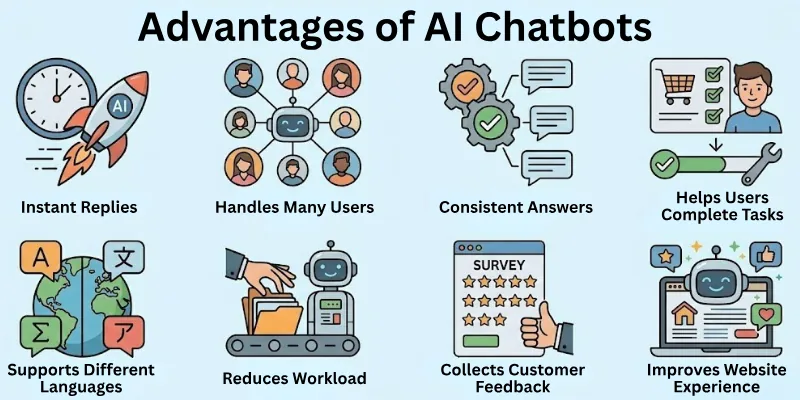
Here is the list of advantages of AI chatbots:
- Instant Replies at Any Time
- Handles Many Users Together
- Gives Consistent Answers
- Helps Users Complete Tasks
- Supports Different Languages
- Reduces the Workload of Human Staff
- Collects Customer Feedback Easily
- Improves Website Experience
Let’s look at them in detail.
1. Instant Replies at Any Time
AI chatbots respond within seconds, no matter when a user sends a message. They do not follow working hours, so users always get quick support. This helps reduce delays in communication.
They also keep services active when human teams are not available. This is very helpful for global users who visit websites from different time zones.
- Reduces customer frustration during urgent situations
- Helps users outside business working hours
- Useful for order tracking and quick status checks
- Supports users during holidays and weekends
- Improves trust in online services
2. Handles Many Users Together
AI chatbots can talk to multiple users at the same time without slowing down. This makes them very useful for busy websites or online stores.
They manage high traffic easily, even during sales or product launches. Users do not need to wait in queues for support.
- Manages sudden spikes in website traffic
- Prevents long waiting lines for customers
- Keeps response time stable under load
- Supports multiple queries at once
- Improves service handling during peak hours
3. Gives Consistent Answers
AI chatbots always provide similar answers to the same question. This helps avoid confusion that can happen with human replies.
Businesses use this feature to maintain accuracy in customer communication. It ensures every user gets reliable and uniform information.
- Reduces confusion between different replies
- Maintains message accuracy across users
- Helps in brand consistency
- Avoids human communication errors
- Builds customer confidence in responses
4. Helps Users Complete Tasks
AI chatbots guide users step by step in simple tasks. They can help with bookings, registrations, and order tracking.
This makes online processes easier for users who may not be tech-friendly. It also reduces mistakes during form filling or navigation.
- Assists in online booking processes
- Helps track orders and deliveries
- Supports form filling with guidance
- Reduces user input errors
- Makes digital tasks more beginner-friendly
5. Supports Different Languages
Many AI chatbots can understand and respond in multiple languages. This allows businesses to connect with users from different regions.
It also makes communication easier for users who prefer their native language. This improves comfort and understanding.
- Helps businesses reach global audiences
- Improves communication for non-English users
- Supports multilingual customer service
- Breaks language barriers in support
- Increases accessibility for diverse users
6. Reduces the Workload of Human Staff
AI chatbots handle repeated and simple questions. This reduces pressure on human customer support teams.
Employees can then focus on complex issues that need personal attention. This improves overall efficiency in the workplace.
- Frees staff from repetitive tasks
- Reduces customer support workload
- Saves time for human agents
- Improves team productivity
- Allows focus on high-value tasks
7. Collects Customer Feedback Easily
AI chatbots can ask users for feedback after service or interaction. This helps businesses understand customer needs better. The collected data can be used to improve products and services. It also helps in identifying common problems quickly.
- Collects real-time user opinions
- Identifies common customer issues
- Helps improve service quality
- Supports business decision-making
- Tracks user satisfaction trends
8. Improves Website Experience
AI chatbots guide visitors when they enter a website. They help users find information quickly without searching manually. This makes the website easier to use and more interactive. Users often stay longer when they get instant help.
- Improves website navigation experience
- Helps users find pages faster
- Reduces bounce rate on websites
- Increases user engagement time
- Makes websites more interactive and helpful
Disadvantages of AI Chatbots
AI chatbots help businesses automate customer support and improve response speed. But they also come with some clear limits that can affect user experience.
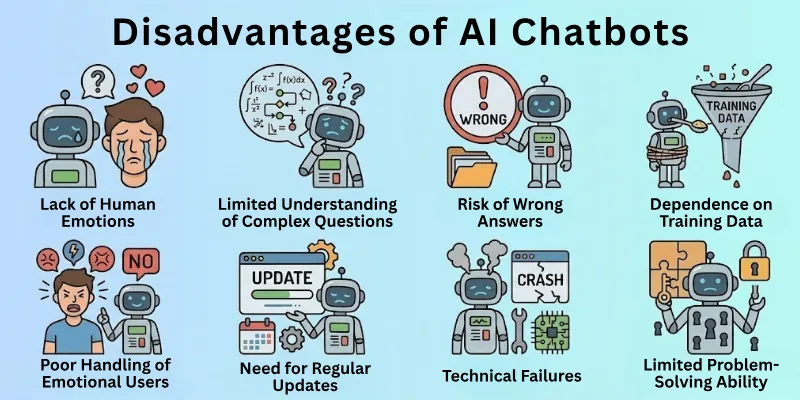
It is important to understand these challenges before using them in real systems.
- Lack of Human Emotions
- Limited Understanding of Complex Questions
- Risk of Wrong Answers
- Dependence on Training Data
- Poor Handling of Emotional Users
- Need for Regular Updates
- Technical Failures and Downtime
- Limited Problem-Solving Ability
Before we explore each disadvantage, it is important to note that AI chatbots work best for simple tasks. When situations become complex or emotional, their limitations become more visible.
1. Lack of Human Emotions
AI chatbots cannot feel emotions like humans. They only follow programmed responses. This makes their replies sound flat or less caring in sensitive situations.
Users may feel disconnected when they need emotional support. This becomes a problem in customer service, where empathy is important.
- Cannot understand human feelings deeply
- Gives neutral or robotic responses
- Not suitable for emotional conversations
- May reduce customer satisfaction in sensitive cases
- Lacks personal touch in communication
2. Limited Understanding of Complex Questions
AI chatbots struggle with complicated or unclear questions. They work best when questions are simple and direct. When users ask mixed or detailed queries, the chatbot may fail to understand correctly. This leads to incomplete or wrong answers.
- Struggles with multi-layered questions
- Misunderstands unclear instructions
- Cannot handle deep technical discussions
- Breaks down with long or complex queries
- Requires simple input to respond correctly
3. Risk of Wrong Answers
AI chatbots can sometimes give incorrect or outdated information. This happens when the system is not updated properly. Wrong answers can confuse users and reduce trust in the service. Businesses need to monitor responses carefully.
- May share incorrect information
- Depends on the quality of training data
- Can mislead users in important cases
- Needs constant monitoring
- May affect brand credibility
4. Dependence on Training Data
AI chatbots learn from the data they are trained on. If the data is limited or biased, the responses will also be weak. This makes the chatbot less reliable in new or unknown situations. It cannot think beyond its training.
- Works only within trained data limits
- Cannot learn new situations instantly
- May repeat outdated patterns
- Performs poorly with missing data
- Needs continuous improvement
5. Poor Handling of Emotional Users
When users are angry, upset, or frustrated, chatbots often fail to respond properly. They cannot adjust tone like humans. This can increase user frustration instead of solving it. Human support is still needed in such cases.
- Cannot calm upset customers effectively
- Fails to adjust emotional tone
- May give unrelated responses
- Increases user dissatisfaction
- Not suitable for sensitive complaints
6. Need for Regular Updates
AI chatbots require regular updates to stay accurate and useful. Without updates, their performance can drop quickly. Businesses must invest time and effort to maintain them properly.
- Needs continuous system training
- Requires content updates over time
- Can become outdated quickly
- Demands technical maintenance
- Increases long-term management effort
7. Technical Failures and Downtime
AI chatbots depend on servers and internet systems. If there is a technical issue, the chatbot may stop working. This can interrupt customer support and create delays for users.
- Stops working during server issues
- Depends on a stable internet connection
- Can crash during high traffic
- Interrupts customer service flow
- Needs backup systems for reliability
8. Limited Problem-Solving Ability
AI chatbots cannot think like humans. They follow patterns instead of real reasoning. When a problem is new or unusual, they often fail to provide a proper solution.
- Cannot handle unexpected problems
- Lacks creative thinking ability
- Follows fixed response patterns
- Struggles with unique cases
- Needs human support for complex issues
Types of AI Chatbots
AI chatbots come in different types based on how they work and how smart they are. Each type has its own purpose and level of understanding. Some chatbots follow simple rules, while others use advanced AI to learn and improve over time.
Below are the main types of AI chatbots explained in simple words:
- Rule-Based Chatbots: Follow fixed rules and give answers based on pre-set options.
- Keyword-Based Chatbots: Detect keywords in user messages and reply with matching answers.
- Menu-Based Chatbots: Work through buttons and menus instead of free typing.
- AI-Powered Chatbots: Use artificial intelligence to understand user intent and give smart replies.
- Machine Learning Chatbots: Learn from past conversations and improve responses over time.
- Hybrid Chatbots: Combine rule-based logic and AI features for better performance.
- Voice Chatbots: Understand and respond to spoken voice commands.
- Contextual Chatbots: Remember previous messages to give more relevant replies.
Comparison Table: Advantages vs Disadvantages of AI Chatbots
AI chatbots offer many benefits, but they also have some clear limitations. The table below helps you understand both sides in a simple and clear way:
| Advantages of AI Chatbots |
|---|
|
| Disadvantages of AI Chatbots |
|---|
|
Conclusion
In this guide, we have covered the pros and cons of AI Chatbots. AI chatbots are helpful in many areas, but they also need proper handling to avoid mistakes.
I suggest using them as a support tool, not a full replacement for humans. With regular monitoring and updates, we can manage most of their challenges easily.
Thank you for staying with this guide till the end. I hope you found it useful and easy to understand.
Don’t skip the next part of the FAQs. I hope you will find something more interesting, so don’t miss it. If you miss it, you may lose something new.
FAQs: Advantages and Disadvantages AI Chatbots
Here are some frequently asked questions related to the advantages and disadvantages of AI chatbots:
AI chatbots are smart software tools that answer user questions automatically. They use artificial intelligence to understand messages and give replies. Many businesses use them in websites, apps, and social media for customer support.
AI chatbots help businesses respond faster and support customers 24/7. They also reduce workload and improve customer satisfaction. This makes business operations more efficient and cost-effective.
Key benefits of AI chatbots include:
- Instant customer support
- 24/7 availability
- Lower support costs
- Better user experience
AI chatbots cannot fully understand human emotions and complex questions. They may also give incorrect answers if not trained properly. This can affect customer trust and service quality.
AI chatbots are better for quick and simple questions. Human agents are better for emotional and complex issues. The best customer service uses both together for balance.
AI chatbots improve customer service by giving instant responses. They reduce waiting time and guide users quickly. This leads to a smoother and faster support experience.
They improve service by:
AI chatbots improve customer service by giving instant responses. They reduce waiting time and guide users quickly. This leads to a smoother and faster support experience.
They improve service by:
- Reducing customer wait time
- Providing 24/7 help
- Answering common questions
- Improving response speed
AI chatbots are used in e-commerce, banking, healthcare, and education. They help users with orders, bookings, and basic support. Their use is increasing in almost every industry.
Yes, AI chatbots can sometimes provide wrong or outdated information. This happens due to limited or incorrect training data. Businesses must regularly update them to improve accuracy.




- Be Respectful
- Stay Relevant
- Stay Positive
- True Feedback
- Encourage Discussion
- Avoid Spamming
- No Fake News
- Don't Copy-Paste
- No Personal Attacks
- Be Respectful
- Stay Relevant
- Stay Positive
- True Feedback
- Encourage Discussion
- Avoid Spamming
- No Fake News
- Don't Copy-Paste
- No Personal Attacks
