Top Advantages and Disadvantages of Blogging in 2026
Published: 17 Apr 2026
Many beginners start blogging with big dreams, but quickly feel stuck when they do not get results. They struggle with traffic, ideas, and motivation.
Understanding the advantages and disadvantages of blogging can help you avoid these early mistakes. Blogging can give you freedom, income, and creativity, but it also requires time, effort, and learning new skills.
In this article, we will guide you through both the benefits and challenges in a simple way. This will help you stay prepared, avoid frustration, and build your blog with confidence and clarity.
Let’s make your journey easier!
Advantages of Blogging in Business
Blogging is more than just writing content online. It helps you share ideas, improve your skills, and reach new people. With time, it can open doors to growth and learning opportunities.
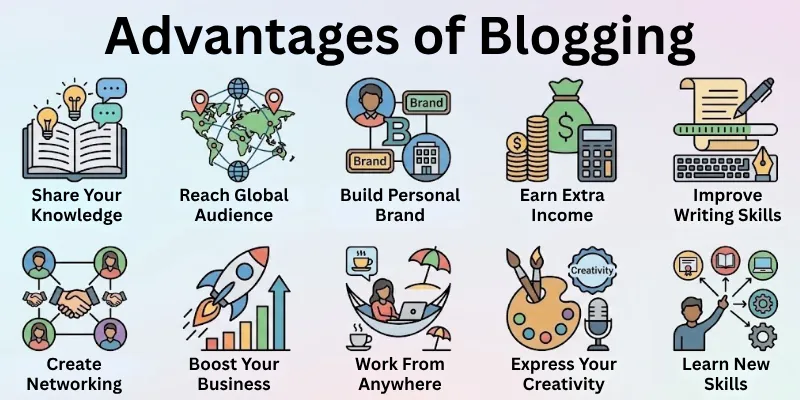
Below are the main benefits of blogging explained in a clear and useful way.
- Share Your Knowledge
- Reach a Global Audience
- Build Personal or Business Brand
- Earn Extra Income
- Improve Writing Skills
- Create Networking Opportunities
- Boost Your Business
- Work From Anywhere
- Express Your Creativity
- Learn New Skills
Let’s examine them closely to understand the advantages of a blog clearly and simply.
1. Share Your Knowledge
Blogging gives you a practical way to share what you know with a wide audience. You can explain topics in simple terms and help readers solve real problems. Over time, this builds your credibility in your niche.
As your content grows, people start relying on your blog for clear and useful information. This creates a strong foundation of trust between you and your readers.
- Your content can keep attracting readers long after publishing
- Simple explanations often perform better than complex writing
- You can cover topics that lack clear guidance online
- Blog posts help organize your own understanding of a subject
- Helpful content increases shares and engagement
- Readers return when they find consistent value
2. Reach a Global Audience
A blog removes geographical limits and allows you to reach readers worldwide. Your content can appear in search results and bring traffic from different countries.
This global exposure helps you grow faster than traditional methods of communication or marketing. One well-written post can reach thousands of people.
- Search engines can bring traffic from any country
- Content remains accessible at all times
- Even old posts can generate ongoing traffic
- Trending topics can bring rapid exposure
- One post can reach a large audience without paid ads
- Simple language improves global understanding
3. Build Personal or Business Brand
Blogging helps you create a clear identity online. When you consistently publish useful content, people start recognizing your name or business. This recognition slowly turns into authority. Readers begin to trust your opinions and consider you reliable in your field.
- A consistent writing style strengthens your identity
- Regular content builds long-term credibility
- Readers associate you with your niche expertise
- Strong content helps you stand out in the competition
- Search engines also recognize your authority over time
- Trust increases naturally through helpful information
4. Earn Extra Income
Blogging can develop into a reliable income source over time. Many bloggers start as beginners and later turn their blogs into full-time work. Income depends on traffic, consistency, and content quality. With time, multiple earning methods can work together.
- Older posts can still generate passive income
- Multiple income streams can work at the same time
- Traffic growth directly improves earning potential
- Niche selection influences long-term success
- Quality content attracts brand collaborations
- Blogging can scale without major extra cost
5. Improve Writing Skills
Regular blogging improves your writing naturally. You learn how to explain ideas in a simple and structured way that readers understand easily. This skill becomes useful in almost every professional area, from business communication to content creation.
- Writing regularly improves clarity and flow
- Editing helps you remove unnecessary information
- You learn to structure ideas more effectively
- Feedback helps refine your writing style
- Communication becomes more confident over time
- Complex ideas become easier to simplify
6. Create Networking Opportunities
Blogging connects you with other writers, professionals, and industry experts. These connections often lead to valuable collaborations. Networking plays an important role in growth because it opens opportunities that are difficult to achieve alone.
- Collaboration expands your audience reach
- Guest posting improves visibility and authority
- Online communities support learning and growth
- Professional relationships open new opportunities
- Industry insights become easier to access
- Partnerships often develop through consistent interaction
7. Boost Your Business
For businesses, blogging works as a long-term marketing tool. It helps attract potential customers and explains products or services in detail. Helpful content builds trust, which plays a major role in converting visitors into customers.
- Content improves customer understanding of services
- Blogs attract organic traffic from search engines
- Educational posts reduce customer confusion
- Trust builds through informative content
- Each blog post supports long-term marketing goals
- Content continues working without ongoing cost
8. Work From Anywhere
Blogging offers complete flexibility in where and how you work. You are not tied to a fixed location or office environment. This freedom allows a better work-life balance and more control over your schedule.
- Work can be done from home or while travelling
- Flexible timing improves productivity
- No commuting saves time and energy
- Work can match your personal routine
- Comfortable environment increases focus
- Independence supports long-term consistency
9. Express Your Creativity
A blog gives you space to express ideas in your own style. You can choose topics, tone, and presentation freely. This creative control makes blogging more engaging and personally satisfying.
- You can experiment with different content styles
- Storytelling makes content more engaging
- Visual elements improve presentation
- Personal voice adds uniqueness
- Topic selection is completely flexible
- Creativity improves with regular practice
10. Learn New Skills
Blogging naturally builds important digital skills. As you manage your blog, you learn how online platforms and content systems work. These skills are useful for career growth and personal development.
- SEO improves your understanding of search behaviour
- Analytics help you study reader activity
- Content tools improve technical confidence
- Research skills strengthen over time
- Marketing knowledge develops naturally
- Online systems become easier to understand
Disadvantages of Blogging
Blogging offers many benefits, but it also comes with some real challenges.
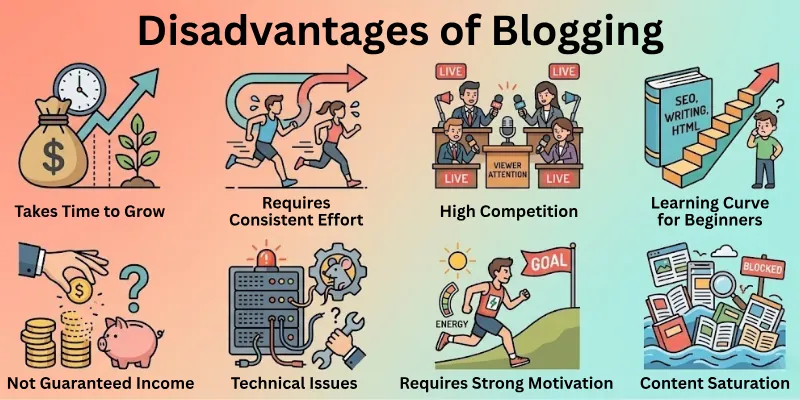
Understanding these drawbacks helps you set the right expectations and plan better for long-term success.
- Takes Time to Grow
- Requires Consistent Effort
- High Competition in Almost Every Niche
- Learning Curve for Beginners
- Not Guaranteed Income
- Technical Issues
- Requires Strong Motivation
- Content Saturation Problem
Let’s take a closer look at each point.
1. Takes Time to Grow
Blogging is not a quick process. You need time to write content, optimize it, and wait for search engines to rank it. Many beginners expect fast results, but real growth usually comes slowly.
You also need patience to see traffic and income increase. Consistency matters more than speed in blogging success.
- Results often take weeks or months to appear
- Regular content updates are required for growth
- Old posts need improvements over time
- Traffic builds slowly in the beginning stage
- Competition can delay ranking results
- Patience is essential for long-term success
2. Requires Consistent Effort
A blog needs regular attention to stay active. If you stop posting or updating, your traffic can drop quickly. Consistency is one of the most important factors in blogging. Without it, growth becomes difficult and unstable.
- The posting schedule must be maintained regularly
- Content updates are needed to stay relevant
- Reader engagement requires continuous effort
- SEO performance improves with steady work
- Irregular activity reduces visibility
- Long gaps can affect audience trust
3. High Competition in Almost Every Niche
Blogging is popular, so competition is high in almost every topic. Many websites may already cover the same ideas. To stand out, you need quality content and a clear focus. Without a strategy, it becomes difficult to gain visibility.
- Many websites target the same keywords
- Ranking on search engines becomes challenging
- Unique content is necessary to stand out
- A strong SEO strategy is required for growth
- Established blogs already dominate many topics
- New bloggers need time to compete
4. Learning Curve for Beginners
Blogging is easy to start, but difficult to master. You need to learn different skills like SEO, content writing, and basic website management. At the beginning, this learning process can feel overwhelming. But with practice, it becomes easier.
- SEO basics must be learned for visibility
- Content writing requires practice and improvement
- Website tools take time to understand
- Analytics can feel confusing at first
- Marketing knowledge is needed for traffic growth
- Continuous learning is part of blogging
5. Not Guaranteed Income
Blogging can generate income, but it is not fixed or guaranteed. Earnings depend on traffic, niche, and strategy. Many beginners take time before earning their first income. Some may not earn at all if they lack consistency.
- Income depends on traffic levels
- Earnings vary from month to month
- New blogs may take time to monetize
- Multiple income sources are needed for stability
- Algorithm changes can affect earnings
- Results are not immediate or predictable
6. Technical Issues
Blogging involves managing a website, which can sometimes create technical challenges. Issues like downtime or errors may affect performance. Even small technical problems can impact user experience and traffic.
- Website errors can affect visibility
- Hosting issues may cause downtime
- Security risks like hacking can occur
- Plugins may conflict with each other
- Speed issues affect user experience
- Regular maintenance is required
7. Requires Strong Motivation
Blogging needs long-term motivation. Since results are slow at the start, many people lose interest too early. Staying motivated is important if you want to succeed in blogging.
- Slow progress can reduce motivation
- Lack of early income may cause frustration
- Competition can feel discouraging
- Consistency becomes difficult over time
- Long-term commitment is required
- Passion helps maintain effort
8. Content Saturation Problem
Many topics online already have thousands of articles. This makes it harder for new content to stand out. You need unique angles and better quality to compete effectively.
- Most topics are already widely covered
- Duplicate ideas reduce visibility chances
- A fresh outlook is needed for ranking
- Content must provide extra value
- Strong SEO becomes even more important
- Creativity is required to stand out
Tips to Maximize Advantages and Minimize Disadvantages
Blogging becomes much more effective when you follow the right approach from the start. If you manage your time, strategy, and content properly, you can enjoy the benefits while reducing most of the common challenges. The key is to stay consistent, plan your work, and keep improving step by step.
Here are some practical tips to help you get better results:
- Focus on one clear niche so your content stays organized and easy to rank
- Follow a regular posting schedule to build trust and improve visibility
- Write simple and helpful content that solves real user problems
- Use basic SEO practices like keywords, headings, and internal linking
- Spend time on content planning before writing to avoid confusion
- Improve gradually by learning from analytics and user behaviour
- Promote your posts on social media platforms to increase reach
- Update old content regularly to keep it fresh and accurate
- Avoid copying others and focus on original and valuable ideas
- Stay patient and treat blogging as a long-term growth process
Comparison Table: Advantages vs Disadvantages of Blogging
Here is a clear comparison to help you quickly understand both sides of blogging. This table shows the main advantages and disadvantages side by side so you can see how they balance each other:
| Pros of Blogging |
|---|
|
| Disadvantages of Blogging |
|---|
|
Conclusion
In this guide, we have covered the advantages and disadvantages of blogging in detail.We looked at how blogging can help you grow, learn, and even earn, while also facing some real challenges. My personal recommendation is to treat blogging as a long-term process. If you balance your effort, learn from mistakes, and stay consistent, you can handle most problems easily and enjoy better results.
Always remember that progress takes time, but steady effort always pays off in the end.
Thank you for reading this guide. I hope it gave you clear value. Goodbye and take care.
Don’t skip the next part of the FAQs. I hope you will find something more interesting, so don’t miss it. If you miss it, you may lose something new.
FAQs: Blogging Pros and Cons
Before you finish reading, here are some common questions people ask about the pros and cons of blogging. These answers will help you understand the topic in a clearer and more practical way.
The pros and cons of blogs for beginners include both growth benefits and real challenges. Blogging helps you build skills, share knowledge, and earn money online, but it also needs time, patience, and consistency. Understanding both sides helps beginners start in the right way.
Yes, blogging is still a strong career option in 2026 if you focus on SEO and valuable content. It can help you build long-term income and personal branding. However, success depends on consistent effort and smart strategy.
- Low startup cost makes it beginner-friendly
- Strong SEO improves long-term traffic
- Income grows with experience and content
SEO usually takes 3 to 6 months to show real results in blogging. Google needs time to understand and rank your content. Consistent posting and proper keyword use improve results faster.
Yes, you can earn money through Google AdSense, affiliate marketing, and sponsored posts. But income is not instant and depends on traffic and SEO performance. High-quality content plays a major role in earnings.
- Google AdSense pays for ad views and clicks
- Affiliate marketing gives a commission on sales
- Sponsored content comes from brands
Beginners often struggle with keyword research, low traffic, and content ranking. SEO takes time to learn and apply correctly. Many people quit early due to slow results.
No, you do not need advanced technical skills for SEO blogging. A basic understanding of keywords, headings, and content structure is enough. You can learn tools and improve step by step.
To increase traffic, focus on on-page SEO, keyword usage, and content quality. Write helpful articles that solve real user problems. Promotion also helps improve visibility.
- Use long-tail keywords naturally in content
- Write clear and structured blog posts
- Share content on social media platforms
Yes, blogging improves business growth by increasing online visibility and trust. It helps businesses attract potential customers through search engines. Blogs also explain products and services in detail.




- Be Respectful
- Stay Relevant
- Stay Positive
- True Feedback
- Encourage Discussion
- Avoid Spamming
- No Fake News
- Don't Copy-Paste
- No Personal Attacks
- Be Respectful
- Stay Relevant
- Stay Positive
- True Feedback
- Encourage Discussion
- Avoid Spamming
- No Fake News
- Don't Copy-Paste
- No Personal Attacks
