How to Do Competitor Analysis: Step-by-Step Beginner’s Guide
Published: 1 Jun 2026
Running a business without knowing your competitors is like playing a game blindfolded. You never know what moves they are making. They could launch a new product, run discounts, or attract your customers with better marketing—and you wouldn’t even notice.
Competitive analysis methods help you understand your competitors, discover opportunities, and make smarter decisions. It’s not about copying others—it’s about understanding the market and positioning yourself in the best possible way.
In this guide, you’ll learn how to do competitor analysis in a clear and practical way. By following these steps, you’ll gain insights that can help grow your business faster and smarter.
So, let’s get started!
7 Competitor Analysis Steps
Understanding your competitors is crucial to growing your business. By studying their strategies, products, and marketing, you can find opportunities to improve and stand out.
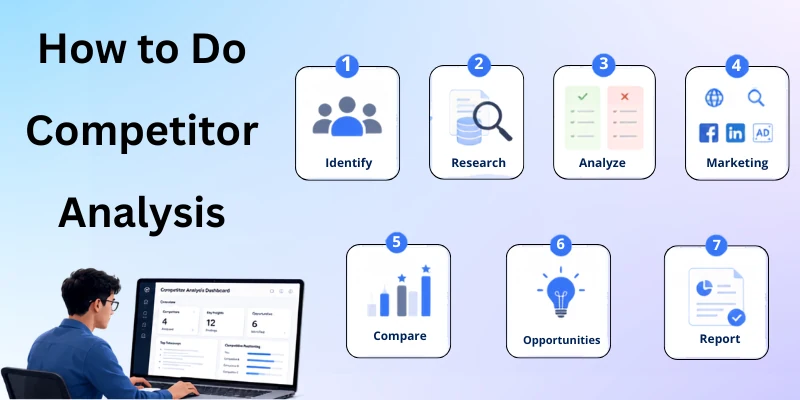
Follow these seven steps of competitive analysis research to get started:
- Identify Your Competitors
- Collect Competitor Information
- Analyze Strengths and Weaknesses
- Study Competitors’ Marketing Strategies
- Benchmark Key Metrics
- Find Market Gaps and Opportunities
- Create a Clear Competitive Analysis Report
Let’s explain the competition analysis examples.
Step 1: Identify Your Competitors
The first step is to know who your competitors really are. Many people think competitors are only those who sell the same product, but there are three types of competitors:
- Direct Competitors: Sell the same product to the same audience.
- Indirect Competitors: Solve the same problem but in a different way.
- Replacement Competitors: People or solutions that replace your product, even if they don’t sell the same thing.
Example: A fitness app has:
- Other fitness apps (direct)
- Home workout videos or diet programs (indirect)
- People tracking fitness manually with pen and paper (replacement)
How to find competitors:
- Search for your product on Google and study the top results
- Check hashtags on Instagram, TikTok, and LinkedIn
- Read reviews on Trustpilot, Amazon, or G2
- Explore Facebook Groups, Reddit threads, and Quora questions
Think like a customer: “If I don’t buy this product from here, where else could I go?” That shows your real competitors.
Step 2: Collect Competitor Information
Once you know your competitors, gather information about them. Focus on what matters most instead of trying to collect everything.
Ask three main questions for each competitor:
- What are they doing?
- Is it working for them?
- Can I do it better?
Areas to focus on:
- Website: How it looks and how easy it is to use
- Pricing: How they position their product
- Products or features: What they offer
- Marketing channels: How they reach customers
- Content: Blog posts, videos, and guides
- Customer reviews: Look for complaints and praise
- Social media: Engagement and activity
3-star reviews are especially useful. They show what customers expected but didn’t get. These are opportunities you can use.
Step 3: Analyze Strengths and Weaknesses
After gathering data, figure out what your competitors do well and where they struggle. A simple SWOT analysis helps:
- Strengths: What they do better than others
- Weaknesses: Where they fail or frustrate customers
- Opportunities: Areas they ignore or miss
- Threats: Things that could harm their business or help you
Example: For a bakery:
- Strength: Fast delivery
- Weakness: No sugar-free options
- Opportunity: Growing demand for healthy desserts
- Threat: New bakery opening nearby
Focus on opportunities and weaknesses to find areas where you can outperform them.
Step 4: Study Competitors’ Marketing Strategies
Understanding how competitors attract and keep customers shows what works and what doesn’t.
Look at these areas:
- SEO and content: Topics they cover and keywords they rank for
- Ads: Messaging, offers, and discounts
- Social media: Frequency, engagement, and style
- Email marketing: How they communicate with subscribers
Analyze their strategies carefully to find gaps and improvements you can make in your own marketing.
Useful tools:
- Google Keyword Planner
- SEMrush or Ahrefs
- BuzzSumo
- Meta Ad Library (for Facebook and Instagram ads)
Step 5: Benchmark Key Metrics
Benchmarking helps you see how your business compares with competitors. Track the metrics that matter most.
Key metrics to watch:
- Website traffic and social media followers
- Search engine rankings and backlinks
- Conversion rates and sales
- Customer reviews and retention
Create a simple scorecard to compare yourself with competitors. Focus on improving the areas where you are weaker.
Example: If competitors have strong social media but weak content, create helpful content that builds trust and authority.
Step 6: Find Market Gaps and Opportunities
Market gaps are needs your competitors aren’t meeting. Finding these gaps helps you attract more customers.
Ways to identify gaps:
- Check customer complaints in reviews
- Look for missing content topics on their blogs or videos
- Identify products or pricing options they don’t offer
- Find customer groups they ignore
Example: If competitors offer only $70/month plans, you can offer a $15 starter plan. If competitors use formal language, you can use friendly, simple language to connect better.
Small differences can make a big impact.
Step 7: Create a Clear Competitive Analysis Report
Finally, compile all your research into a clear, actionable report.
Your report should include:
- Overview of competitors
- SWOT analysis for each competitor
- Key metrics and benchmarks
- Market gaps and opportunities
- Recommended actions for the next 90 days
End your report with specific actions, not just data. For example:
- “Focus on Instagram content targeting 18–30-year-olds to increase brand awareness.”
This way, the report becomes a tool for decision-making, not just a summary of information.
Common Competitive Analysis Tools
Using the right tools can makecompetitive analysis faster, easier, and more accurate. Here are some commonly used tools that help businesses understand competitors and market trends:
- Google Search: The simplest tool to start with. Search for your product or service and see who ranks on the first page. Check competitors’ websites, content, and offers to understand their strategy.
- Google Keyword Planner: Helps you see which keywords competitors are ranking for and what people are searching for. You can also discover new keyword opportunities for your content and SEO.
- SEMrush: A popular tool for SEO and competitive research. It shows competitors’ traffic, keywords, backlinks, and ad strategies. It helps you track your competitors’ online performance in detail.
- Ahrefs: Great for backlink and SEO analysis. Ahrefs helps you see where competitors are getting links, which content performs best, and which keywords drive traffic.
- Ubersuggest: A beginner-friendly tool for keyword research and competitor insights. It shows traffic estimates, top-performing pages, and backlink data.
- SimilarWeb: Provides an overview of competitors’ website traffic, audience demographics, and traffic sources. It’s helpful to see which channels drive the most visitors.
- BuzzSumo: Focuses on content performance. You can find which competitors’ content is most shared on social media, which topics are trending, and what engages their audience.
- Meta Ad Library: A free tool from Facebook to see all active ads from competitors on Facebook and Instagram. It helps you understand their marketing and messaging strategies.
- Social Blade: Tracks social media growth and engagement for competitors on platforms like YouTube, Instagram, and TikTok. Useful for comparing social performance.
- SpyFu: Helps you see competitors’ paid advertising strategies and the keywords they buy on Google Ads. Great for learning their PPC campaigns.
Mistakes to Avoid in Competitive Analysis
Competitive analysis is a powerful tool, but mistakes can reduce its impact. Avoiding common pitfalls ensures your research is accurate and actionable.
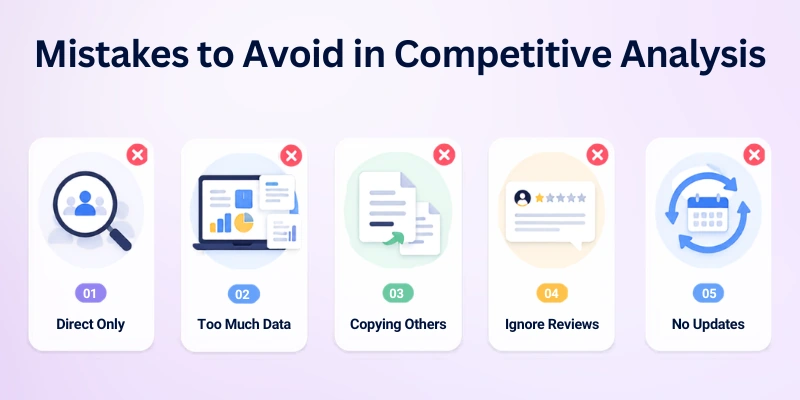
Here are the most frequent errors businesses make—and how to prevent them.
1. Focusing Only on Direct Competitors
Many businesses limit their research to competitors who sell the same product. In reality, indirect competitors and replacement solutions also affect your market share.
For example, in a B2B competitor analysis, a software company may face competition not only from similar tools (direct competitors) but also from alternative methods or manual processes (indirect competitors). Including all types of competitors gives you a complete view of your industry and helps in crafting a stronger competitor analysis marketing plan.
2. Collecting Too Much Data Without a Plan
While gathering data is important, collecting too much without clear goals leads to confusion. Too many charts, links, or numbers can overwhelm you.
Instead, focus on key areas such as pricing, products, marketing strategies, customer feedback, and digital presence. This approach ensures your industry analysis and competitor analysis remain actionable rather than just informative.
3. Copying Competitors Blindly
Trying to imitate competitors’ products, pricing, or campaigns rarely works. Every business is unique, and strategies that succeed elsewhere might not fit your brand.
In a B2B competitor analysis, for example, you can study messaging that resonates with customers but adapt it to your own audience and brand voice. This way, you leverage insights without losing originality in your advertising competitor analysis.
4. Ignoring Customer Feedback
Customer reviews and complaints are gold mines for insight. Ignoring them can make you miss opportunities or repeat mistakes your competitors have already made.
Check reviews across websites, app stores, and social media. Look for patterns in complaints and suggestions to uncover gaps your business can fill. Integrating this step into your competitor analysis marketing plan makes it more realistic and customer-focused.
5. Not Updating Analysis Regularly
Markets change fast. A competitive analysis done once and left untouched quickly becomes outdated.
Set a schedule to review competitors every few months. Regular updates make your industry analysis and competitor analysis current and help you make smarter business decisions.
6. Overlooking Emerging Competitors
Startups or new market entrants can disrupt the industry. Focusing only on established competitors may leave you unprepared for changes.
Including emerging businesses in your B2B competitor analysis ensures you spot trends early and respond quickly.
7. Ignoring Your Own Weaknesses
Competitive analysis isn’t only about others. Ignoring your own weaknesses can prevent growth. Compare your strengths and weaknesses honestly against competitors. This helps create realistic strategies, identify market gaps, and strengthen your advertising competitor analysis.
Final Words
In this article, we have covered how to do a competitor analysis step by step. By studying your competitors, checking their strategies, and spotting opportunities, you can make better business decisions and improve your results.
Use these steps carefully, track your progress, and adjust when needed. What has been your experience with competitor analysis? Share it in the comments below!
FAQs: How to Do Competitor Analysis
Here are some frequently asked questions about how to do competitor analysis to help you understand the process better:
The purpose of a competitor analysis is to understand your competitors’ strengths and weaknesses. It helps you find opportunities in the market and make smarter business decisions. This process ensures your strategies stay competitive and effective.
To create a competitive analysis, start by listing your main competitors and gathering data on their products, pricing, and marketing. Organize this information in a simple chart or table. This makes it easy to compare and identify areas where you can improve.
A competitive review is when you examine your competitors’ products, services, and marketing strategies. It helps you see what works well for them and where they fall short. Conducting a competitive review gives you ideas to enhance your own business.
You can identify competitors by searching online for similar products or services, checking social media, and asking your customers. Knowing who your competitors are helps you understand the market better. This step is essential for building an effective business strategy.
Competitor audience analysis is studying who your competitors’ customers are. Look at their age, interests, and needs. This insight helps you find potential customers your competitors may be missing.
To analyze competitors, focus on their products, pricing, marketing methods, and customer feedback. Compare their strengths and weaknesses with your own business. This shows you where you can improve and stand out in the market.
In digital marketing, competitor analysis means checking competitors’ websites, SEO, online ads, and social media performance. This shows you which strategies attract engagement and leads. Use these insights to improve your own digital marketing efforts.
Knowing your competitors helps you understand market trends and customer expectations. It allows you to position your business uniquely and improve your products or services. Staying aware of competitors ensures you are never caught off guard.




- Be Respectful
- Stay Relevant
- Stay Positive
- True Feedback
- Encourage Discussion
- Avoid Spamming
- No Fake News
- Don't Copy-Paste
- No Personal Attacks
- Be Respectful
- Stay Relevant
- Stay Positive
- True Feedback
- Encourage Discussion
- Avoid Spamming
- No Fake News
- Don't Copy-Paste
- No Personal Attacks
