Top Advantages and Disadvantages of Global Marketing in 2026
Published: 22 Apr 2026
In today’s fast-changing business world, companies are no longer limited to one place. They try new ways to reach people in different countries and grow their presence worldwide.
This shift has made global marketing an important topic for businesses of all sizes. However, it comes with both strong benefits and clear challenges.
In this article on the advantages and disadvantages of global marketing, we will explore how this strategy works in simple terms.
You will see how it helps businesses expand and what issues they may face while working across different markets.
Benefits of Global Marketing
Global marketing helps businesses grow beyond local borders and connect with people in many countries. It opens new opportunities for companies to understand different markets and customer needs. Many global brands use it to strengthen their position and build long-term success.
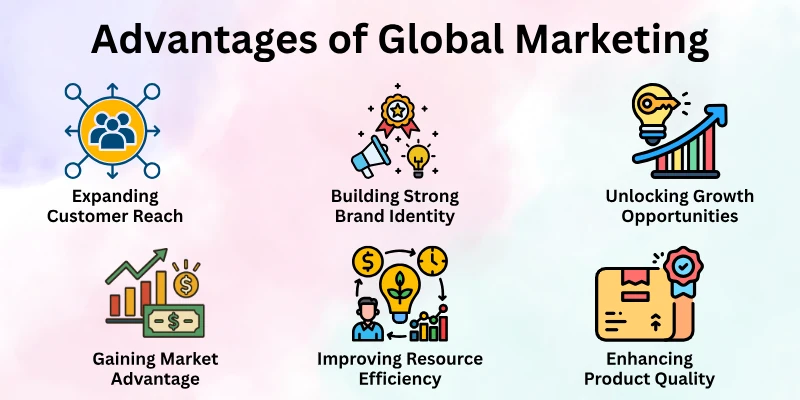
Have a look at some important global marketing advantages.
- Expanding Customer Reach
- Building Strong Brand Identity
- Unlocking Growth Opportunities
- Enhancing Product Quality
- Gaining Market Advantage
- Improving Resource Efficiency
Let’s explain the pros of global marketing in detail.
1. Expanding Customer Reach
Businesses can connect with people in different countries through global marketing. This helps them move beyond a single local area and reach international audiences. More exposure creates more chances for business success.
Different regions also bring different customer behaviours. Companies study these behaviours and adjust their approach. This helps them communicate better with global audiences.
A clothing brand, for example, may sell winter wear in Europe and lighter outfits in Asia based on climate needs.
- Reaches customers across multiple countries
- Helps explore international demand
- Improves understanding of different markets
- Supports global expansion plans
- Increases visibility in foreign regions
2. Building Strong Brand Identity
A consistent global presence helps customers recognize a brand easily. When people see the same logo or message across different countries, trust naturally grows.
Companies maintain a similar brand style across all markets. This creates a strong and unified identity. Customers feel more confident when they see familiarity everywhere.
For example, a soft drink company uses the same branding worldwide, making it instantly recognizable.
- Creates a consistent global image
- Builds customer trust over time
- Improves brand recall value
- Strengthens emotional connection
- Maintains unified communication style
3. Unlocking Growth Opportunities
Global marketing allows businesses to enter new markets and find new customers. This creates many chances for long-term growth.
Companies can also reduce their risk by not depending on one market. If one region performs poorly, another can balance the results. This makes business planning more stable.
A tech company may start in one country and later expand after testing success in other regions.
- Opens new international markets
- Reduces business risk
- Supports steady expansion
- Helps test different audiences
- Encourages long-term planning
4. Enhancing Product Quality
Understanding global customers helps companies improve their products. They learn what different people like and expect from a product.
Feedback from multiple countries helps businesses make better decisions. They adjust features, design, or services based on real needs. This leads to better customer satisfaction.
For example, fast-food chains change their menu items depending on local food preferences.
- Improves product design and features
- Uses global customer feedback
- Encourages innovation in products
- Increases customer satisfaction
- Supports better decision-making
5. Gaining Market Advantage
Companies that use global marketing often stay ahead of competitors. A strong international presence builds confidence and market strength.
Businesses also follow global trends and apply them quickly. This helps them stay relevant in a fast-changing market.
For example, smartphone brands often release updates worldwide to maintain leadership.
- Strengthens competitive position
- Helps follow global trends
- Improves business strategy
- Builds market leadership
- Increases brand influence
6. Improving Resource Efficiency
Global marketing helps companies manage resources in a better way. Large-scale production reduces cost and improves efficiency.
Marketing campaigns can also be reused across countries with small changes. This saves time and effort while maintaining quality.
For example, one global advertisement idea can be adjusted for different languages and cultures.
- Reduces production costs
- Saves marketing time
- Improves operational efficiency
- Supports large-scale planning
- Optimizes global resources
Disadvantages of Global Marketing
Global marketing helps businesses grow, but it also brings many challenges. Companies must deal with different cultures, rules, and customer expectations in each country. This makes international marketing more complex than local marketing.
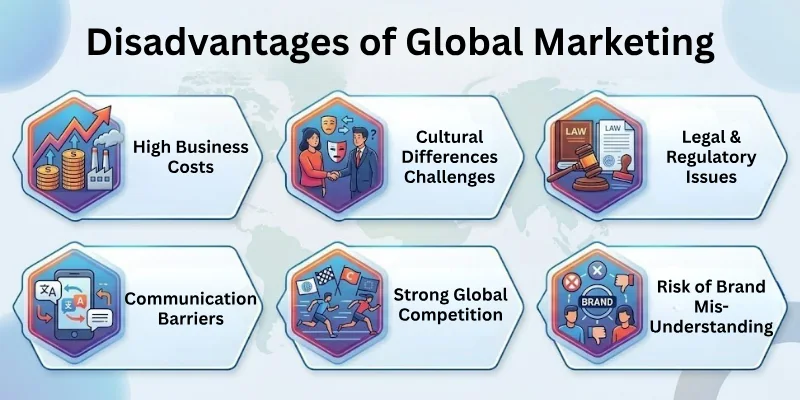
It also requires careful planning and strong research. A small mistake can affect brand image in different regions. That is why companies must understand the risks before entering global markets.
- High Business Costs
- Cultural Differences Challenges
- Legal and Regulatory Issues
- Communication Barriers
- Strong Global Competition
- Risk of Brand Misunderstanding
Let’s explore them in detail.
1. High Business Costs
Expanding into global markets requires a large budget. Companies spend money on advertising, research, and logistics in different countries. This increases overall business expenses.
Marketing campaigns also need changes for each region. This adds extra cost for design, translation, and promotion. Small mistakes can also lead to financial loss.
For example, a brand launching in five countries must invest separately in each market strategy.
- Requires high investment for expansion
- Increases marketing and research costs
- Needs separate campaigns for regions
- Raises operational expenses
- Can be risky for small businesses
2. Cultural Differences Challenges
Different countries have different traditions, values, and lifestyles. A message that works in one country may not work in another. This creates communication challenges.
Companies must carefully study each culture before promoting products. If they ignore cultural differences, it can lead to misunderstanding or rejection.
For example, an advertisement that looks normal in one country may be considered inappropriate in another.
- Different cultures affect marketing messages
- Requires deep market research
- Risk of misunderstanding the audience
- Needs message customization
- Increases planning complexity
3. Legal and Regulatory Issues
Every country has its own business laws and rules. Companies must follow all regulations when entering a new market. This can slow down business expansion.
Some countries also have strict advertising or import rules. Businesses must adjust their strategies to meet legal requirements. Ignoring rules can lead to penalties.
For example, product labelling laws may differ from country to country.
- Different laws in every country
- Slows down the market entry process
- Requires legal compliance checks
- Increases documentation work
- Risk of penalties for violations
4. Communication Barriers
Language differences can create problems in global marketing. A message may lose its meaning when translated into another language. This affects customer understanding.
Even small translation errors can confuse customers. Businesses must hire experts to ensure clear communication across all markets.
For example, a slogan may sound good in English but lose impact in another language.
- Language differences cause confusion
- Translation errors affect meaning
- Requires professional localization
- Increases communication effort
- May reduce message impact
5. Strong Global Competition
Global markets are highly competitive. Companies not only compete with local brands but also with international companies. This increases pressure on businesses.
It becomes difficult to stand out in crowded markets. Companies must constantly improve their strategies to stay relevant.
For example, smartphone companies compete globally with many strong brands at the same time.
- High competition from global brands
- Difficult to maintain market position
- Requires continuous innovation
- Increases marketing pressure
- Demands strong strategy planning
6. Risk of Brand Misunderstanding
A message that works in one country may not be understood correctly in another. This can damage brand reputation.
Companies must carefully adjust their marketing content. If they fail, customers may react negatively or lose trust in the brand.
For example, a campaign that is funny in one culture may feel offensive in another.
- Risk of wrong brand interpretation
- Can damage the company’s image
- Requires careful message planning
- Needs cultural sensitivity
- May affect customer trust
Global Marketing vs Local Marketing
Understanding the difference helps companies choose the right strategy for better results in the market.
| Global Marketing | Local Marketing |
| Targets customers in multiple countries | Targets customers in one city or region |
| Uses one main brand message worldwide | Changes message based on local needs |
| Focuses on large-scale business growth | Focuses on community-level growth |
| Requires a high budget and planning | Usually needs a lower budget |
| Follows global trends and standards | Focuses on local culture and preferences |
| Uses standardized or adapted campaigns | Uses highly customized campaigns |
| Faces international competition | Faces local competition |
| Needs complex logistics and coordination | Easier to manage operations |
| Builds global brand identity | Builds strong local trust |
| Expands business internationally | Strengthens local market presence |
Future of Global Marketing
Global marketing is changing very fast with new technology and customer needs. Businesses are no longer only focused on selling products. They now focus on better customer experience, digital tools, and smarter communication across countries.
In the coming years, companies will use more advanced methods to understand people in different regions. This will make global marketing more personal, fast, and data-driven.
Here are some key points that show the future of global marketing:
- Artificial intelligence will help companies understand customer behaviour better
- Digital marketing will become the main way to reach global audiences
- More brands will create personalized ads for different regions
- Social media will play a bigger role in global brand promotion
- E-commerce platforms will continue to expand worldwide
- Companies will focus more on local culture while staying globally connected
- Automation will make marketing faster and more efficient
- Data analytics will guide better decision-making in real time
- Video content will become more important for global engagement
Conclusion
In this article, we have clearly explained the advantages and disadvantages of global marketing to help you understand the full picture. We covered how businesses expand globally and what difficulties they may face in different markets.
Overall, global marketing is a powerful strategy, but it needs proper research and careful execution. When used in the right way, it can support long-term success for businesses of all sizes.
Don’t forget to check the FAQs section below. It includes simple answers to common questions that can help you understand even more. Skipping it may mean missing some useful information that adds extra clarity.
FAQs on Advantages and Disadvantages of Global Marketing
Below are some commonly asked questions that help you understand the pros and cons of global marketing in a simple and clear way.
The advantages of global marketing include wider customer reach, stronger brand awareness, and better business growth. It helps companies expand into new markets and improve their global presence. Many brands use it to increase international sales and recognition.
The disadvantages of global marketing include high costs, cultural differences, and legal challenges. Businesses may also face language barriers and strong global competition. These issues can affect international business success if not managed well.
Companies use global marketing strategies to grow their business beyond local markets. It helps them increase sales, reach global audiences, and build a strong international brand. This strategy is important for long-term business expansion.
Global marketing can help small businesses grow by reaching international customers. However, it also requires investment, planning, and market research. Without a proper strategy, small businesses may struggle in global markets.
Global marketing comes with several challenges that companies must manage carefully. These challenges can affect performance and global success.
- High cost of global advertising and operations
- Cultural differences in customer behavior
- Language and communication barriers
- Different international laws and regulations
- Strong competition from global brands
Global marketing focuses on selling products in multiple countries, while local marketing targets a specific region. Global marketing uses international strategies, while local marketing focuses on local customer needs. Both play an important role in business growth.
Yes, global marketing is good for business growth when used with the right strategy. It helps companies expand into international markets and increase revenue. Proper planning is important for successful global expansion.
Large multinational companies use global marketing the most, especially in the technology, food, and fashion industries. These companies operate in many countries and maintain a strong global brand. They use international strategies to stay competitive.




- Be Respectful
- Stay Relevant
- Stay Positive
- True Feedback
- Encourage Discussion
- Avoid Spamming
- No Fake News
- Don't Copy-Paste
- No Personal Attacks
- Be Respectful
- Stay Relevant
- Stay Positive
- True Feedback
- Encourage Discussion
- Avoid Spamming
- No Fake News
- Don't Copy-Paste
- No Personal Attacks
