Advantages and Disadvantages of Voice Search Optimization in 2026
Published: 10 Aug 2026
Voice search is growing very fast across the world. Millions of people now use smart assistants like Google Assistant, Siri, and Alexa every day.
This change has made voice search optimization an important part of digital marketing. The advantages and disadvantages of voice search optimization help businesses understand how this technology affects online visibility.
It improves user experience and makes searching faster, but it also brings new challenges for SEO.
In this article, we will explore both sides in a simple way so you can clearly understand how voice search impacts websites and online growth today.
Advantages of Voice Search Optimization
Voice search has become a normal part of daily life. People now speak to their devices instead of typing long queries. This change has made search faster and more natural for users. It also helps websites reach people in a more direct way.
For business owners and content creators, this shift brings new opportunities. It changes how users find information and how search engines show results. Understanding these benefits can help you smartly improve your online presence.
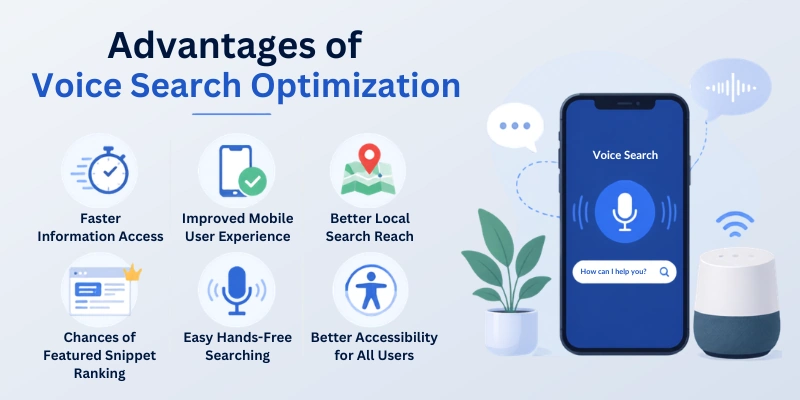
Have a look at some important benefits of Voice Search Optimization.
- Faster Information Access
- Improved Mobile User Experience
- Better Local Search Reach
- Higher Chances of Featured Snippet Ranking
- Easy Hands-Free Searching
- Better Accessibility for All Users
Let’s cover them in detail.
1. Faster Information Access
Voice search helps users get answers very quickly. People do not need to type long queries. They just speak and get instant results. This saves time and makes searching more efficient in daily life.
It also helps users who want quick solutions without scrolling through many pages. Search engines try to give direct answers through voice results. This improves overall user satisfaction and speeds up the search process.
Example: A user asks, “What is the weather today?” and gets an instant spoken reply.
- Reduces search time
- Gives direct answers
- Works well for quick questions
- Improves user satisfaction
- Supports real-time information needs
2. Improved Mobile User Experience
Voice search works very well on mobile phones. It removes the need for typing on small screens. This makes the experience smooth and comfortable for users.
Many people use smartphones while travelling or multitasking. Voice search helps them find information without stopping their work. It makes mobile usage more practical and user-friendly.
Example: A user searches for a restaurant while walking without typing anything.
- Easy on small screens
- Saves effort while typing
- Supports multitasking
- Works with mobile apps
- Improves user comfort
3. Better Local Search Reach
Voice search helps users find nearby places very easily. People often ask for services “near me” using voice commands. This increases visibility for local businesses.
It connects users with nearby shops, restaurants, and services quickly. Businesses that optimize for voice search can attract more local customers.
Example: “Find a pharmacy near me” gives instant nearby results.
- Improves local business visibility
- Supports “near me” searches
- Increases foot traffic
- Helps small businesses grow
- Connects users with nearby services
4. Higher Chances of Featured Snippet Ranking
Voice search often uses featured snippets as answers. These are short and clear responses shown at the top of search results. If your content is well-optimized, it can appear in this spot.
This increases the chances of your website getting more attention. Search engines prefer simple and direct answers for voice results.
Example: A question like “What is SEO?” can trigger a featured snippet answer.
- Improves search ranking visibility
- Increases organic reach
- Supports a quick answers format
- Builds authority in search results
- Boosts website exposure
5. Easy Hands-Free Searching
Voice search allows users to search without using their hands. This is helpful when they are busy or doing other tasks. It makes searching more flexible.
People use it while cooking, driving, or working. It adds comfort and convenience to everyday life.
Example: A user asks for directions while driving.
- Works without typing
- Useful during multitasking
- Supports daily activities
- Increases convenience
- Saves physical effort
6. Better Accessibility for All Users
Voice search helps people who find typing difficult. It supports users with disabilities and older adults. This makes the internet more inclusive.
It allows everyone to search easily using their voice. This improves access to information for a wider audience.
Example: An elderly person asks a question instead of typing it.
- Supports disabled users
- Helps elderly people
- Makes search more inclusive
- Reduces typing difficulty
- Improves digital access
Disadvantages of Voice Search Optimization
Voice search is useful, but it also comes with some limits. It does not always work perfectly for every user or every website. Many businesses still face challenges when they try to adjust to it.
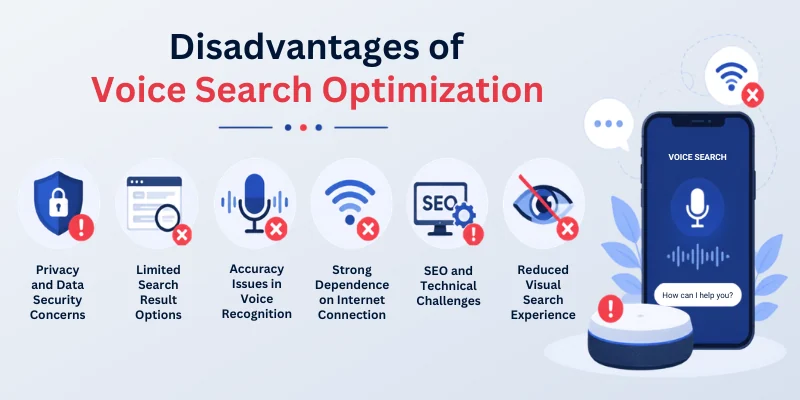
Let’s look at some important disadvantages of Voice Search Optimization.
- Privacy and Data Security Concerns
- Limited Search Result Options
- Accuracy Issues in Voice Recognition
- Strong Dependence on Internet Connection
- SEO and Technical Challenges
- Reduced Visual Search Experience
Let’s explain them in detail.
1. Privacy and Data Security Concerns
Voice search uses microphones to listen to user commands. Some users feel uncomfortable with this because they worry about privacy. They think their conversations may be recorded.
Even if systems are secure, users still feel unsure. This reduces trust for some people. It becomes a concern for businesses that rely on user confidence.
Example: A user avoids voice search because they fear their device is always listening.
- Raises privacy concerns
- Creates trust issues
- Users may disable voice features
- Sensitive data risk fears
- Affects user confidence
2. Limited Search Result Options
Voice search usually gives only one main answer. It does not show a full list of websites like a normal search. This reduces choices for users.
It can also limit traffic for websites that are not selected as the top answer. Many useful pages may not get visibility.
Example: A voice assistant reads only one restaurant name instead of showing multiple options.
- Shows limited results
- Reduces website visibility
- Lowers user choice options
- Affects traffic distribution
- Favours top-ranked pages only
3. Accuracy Issues in Voice Recognition
Voice search does not always understand words correctly. Accents, pronunciation, and background noise can create errors. This affects search quality.
Sometimes users get wrong or unrelated answers. This makes the experience less reliable for some people.
Example: A user says a word, but the assistant shows a different result.
- Misunderstands spoken words
- Affected by accents
- Background noise interference
- Incorrect search results
- Reduces user satisfaction
4. Strong Dependence on Internet Connection
Voice search needs a stable internet connection. Without it, it does not work properly. Slow internet can delay responses.
This becomes a problem in areas with weak connectivity. Users may face frustration when results do not load quickly.
Example: A voice command fails in a low network area.
- Requires strong internet
- Slow connection affects speed
- Fails in weak network zones
- Interrupts user experience
- Limits usability in remote areas
5. SEO and Technical Challenges
Voice search optimization needs special SEO techniques. Websites must use natural language and structured data. This can be difficult for beginners.
Not all websites can easily rank for voice search. It requires extra effort and technical knowledge.
Example: A small blog may struggle to appear in voice results.
- Requires advanced SEO skills
- Needs structured data setup
- Hard for beginners
- Competitive ranking system
- Continuous optimization needed
6. Reduced Visual Search Experience
Voice search gives spoken answers instead of showing full pages. Users cannot easily compare different options. This reduces the visual browsing experience.
Some users prefer reading and comparing information. Voice search does not support this style well.
Example: A user wants to compare products but only hears one suggestion.
- No visual comparison
- Limited browsing experience
- Reduces detailed exploration
- Focuses only on single answers
- Not ideal for research-heavy tasks
How to Optimize for Voice Search
Voice search optimization helps your website appear in spoken search results. You need to write content in a simple and natural way so search engines can easily understand it. When you follow the right steps, your chances of ranking in voice results improve.
This section shows practical ways to make your website ready for voice search. These tips are easy to apply and work well for beginners.
Key Ways to Optimize for Voice Search
- Use simple and natural language in your content
- Write answers in question-and-answer format
- Focus on long-tail keywords (full sentences)
- Add FAQ sections to target common questions
- Improve website loading speed for better performance
- Make your website mobile-friendly and responsive
- Use structured data (schema markup) for better understanding
- Target local keywords like “near me” searches
- Keep answers short and direct for quick results
- Update content regularly to stay relevant
Conclusion
In this article, we have explored the advantages and disadvantages of voice search optimization in a simple and clear way. We learned how voice search is changing the way people find information online.
It helps users get fast answers, improves mobile experience, and supports local searches. At the same time, it also brings challenges like privacy concerns and accuracy issues. Understanding both sides helps you make better decisions for your website or business.
Before you leave, make sure you also check the FAQs section. It has more helpful answers that can clear your doubts and add extra value to your learning. Don’t skip it, because you might miss some useful points that can help you improve your SEO strategy.
FAQs: Pros and Cons of Voice Search Optimization
Below are some common questions that users often ask about voice search SEO. These answers will help you clear your doubts in a simple way and understand the topic better:
This question helps you understand why voice search matters for online visibility. Voice search optimization is important because it matches how people search using voice. It helps your content appear in featured snippets and top results. This improves your website visibility and organic traffic.
Many beginners want to know both the good and bad sides of this topic. voice search optimization has both positive and negative aspects. It improves speed, mobile use, and user convenience. But it also brings challenges like privacy concerns, limited results, and technical SEO difficulty.
This question explains how voice search changes search engine ranking behaviour. Voice search affects SEO by changing ranking priorities. Google prefers short, clear, and direct answers for voice results. Only well-optimized content gets selected for voice responses.
This question explains where voice search is commonly used. Voice search works on many modern smart devices. It is widely used in daily life through digital assistants.
Here are common devices and tools:
- Smartphones with Google Assistant or Siri
- Smart speakers like Amazon Alexa
- Smart TVs with voice control
- Laptops with built-in voice search
Here, we explain simple steps beginners can follow for optimization. You can improve voice search optimization by using simple and natural language. Focus on long-tail keywords and question-based content. Also, improve page speed and mobile usability.
This question focuses on the challenges businesses face. Voice search optimization can reduce visibility for non-optimized websites. It also limits user choices by showing only one main answer. Many businesses find it hard to compete for voice rankings.
This question is important for local business owners. Voice search otimization strongly improves local SEO performance. It helps users find nearby businesses using “near me” searches. This increases local traffic and customer engagement.




- Be Respectful
- Stay Relevant
- Stay Positive
- True Feedback
- Encourage Discussion
- Avoid Spamming
- No Fake News
- Don't Copy-Paste
- No Personal Attacks
- Be Respectful
- Stay Relevant
- Stay Positive
- True Feedback
- Encourage Discussion
- Avoid Spamming
- No Fake News
- Don't Copy-Paste
- No Personal Attacks
