How to Increase Website Traffic Organically and Boost Rankings
Published: 10 Jun 2026
Did you know that over 70% of online traffic comes from organic search? Yet many websites struggle to attract visitors naturally. If you want to grow your audience without relying on paid ads, knowing the right strategies is key.
This article will guide you on how to increase website traffic organically, showing practical tips, from creating valuable content to optimizing your site, so you can steadily attract relevant visitors and build lasting online growth.
Let’s begin and reveal the methods that can grow your website visitors naturally and consistently.
What Is Organic Traffic and Why It Matter
Organic traffic is the visitors who come to your website naturally, usually through search engines like Google, without clicking on paid ads. These are people actively looking for the information, products, or services you offer.
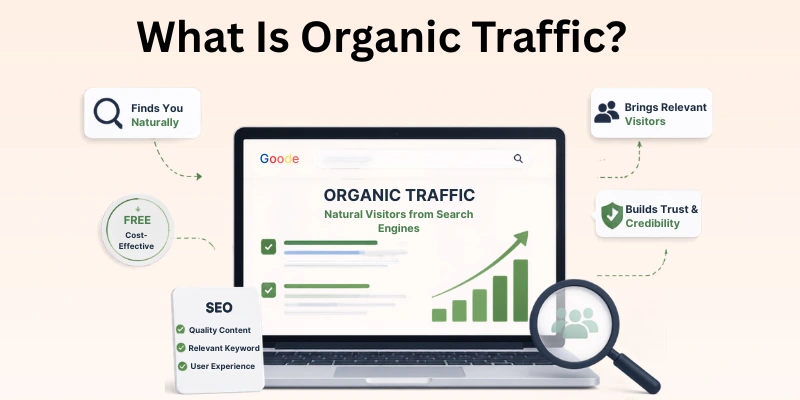
How it’s different from paid traffic:
- Organic traffic: Free, comes from search results or shared links, and grows over time.
- Paid traffic: Comes from ads you pay for, like Google Ads or social media campaigns, and stops when the ads stop.
Long-term benefits:
- Cost-effective: You don’t pay for every visitor.
- Sustainable growth: High-quality content and SEO continue to bring visitors over months or years.
- Builds trust: Users often trust search results more than ads, leading to better engagement.
Focusing on organic traffic helps you attract relevant visitors naturally while creating a foundation for long-term website growth. Now that we understand what organic traffic is and why it matters, it’s time to go deeper.
In the next section, we’ll break down all the key factors that can help you increase your website traffic step by step. This way, you’ll have a clear, practical roadmap to follow and start seeing results naturally.
Understand Your Audience
To get organic traffic, you first need to know who you are writing for. Understanding your audience ensures that your content reaches the right people and answers their real questions. The better you know your visitors, the more relevant and engaging your content will be, which helps it rank higher in search results.
How to use it effectively:
- Identify your target users and their interests or problems.
- Find the questions they are asking and the needs they want solved.
- Match your content to what users intend to do: informational (to learn), navigational (to find something), or transactional (to take action).
- Study your audience’s habits and preferences to make your content more useful.
- Create examples or solutions that directly relate to what your audience is searching for.
Why this matters for organic traffic:
- Helps your content rank naturally in search engines.
- Attracts relevant visitors who are more likely to stay, engage, and return.
Keyword Research & Strategy
Keywords are the words and phrases people type into search engines when looking for answers, products, or services. Choosing the right keywords is essential for organic traffic because they help your content appear in front of the people who are actually searching for it. Doing keyword research the right way ensures your content reaches the right audience and ranks higher in search results.
How to use it effectively:
- Find what your audience is searching for by thinking like them. What would they type to find your content?
- Focus on long-tail keywords, which are longer, more specific phrases that are easier to rank for.
- Analyze competitors to see what keywords similar websites are targeting and identify gaps you can fill.
- Use keyword research tools to find ideas and search volume: Google Keyword Planner, Ahrefs, SEMrush, and Ubersuggest.
- Include keywords naturally in titles, headings, and content; avoid keyword stuffing.
- Use a mix of short-tail (broad) and long-tail (specific) keywords to cover more searches.
- Review and update your keywords regularly as search trends and user behaviour change.
Why this matters for organic traffic:
- Makes your content discoverable when people search for it.
- Attracts relevant visitors who are more likely to stay, engage, and return.
Create High-Quality, User-Centered Content
Great content draws visitors naturally because it gives them value. When your articles answer real questions and are easy to read, people stay longer, share your pages, and come back for more.
How to use it effectively:
- Solve specific problems your audience has.
- Keep sentences and paragraphs short for easy reading.
- Use headings, bullets, and visuals to organize information clearly.
- Include practical examples or tips that readers can apply immediately.
- Refresh content occasionally to keep it accurate and relevant.
- Naturally include your target keywords without forcing them.
Why this matters for organic traffic:
- Attracts visitors who are genuinely interested in your content.
- Encourages engagement and repeat visits.
- Makes other sites more likely to link to your content, improving search rankings.
Craft Effective Title Tags and Meta Descriptions
Your title and meta description are the first things people see in search results. Writing them well increases the chance that users click your link, which drives more organic traffic.
How to use it effectively:
- Include your main keyword naturally in the title and meta description.
- Make titles clear, concise, and appealing—show the benefit of clicking.
- Keep meta descriptions short (around 150-160 characters) and engaging.
- Highlight what problem your content solves or what value it provides.
- Avoid keyword stuffing; write for humans first, search engines second.
Why this matters for organic traffic:
- Better titles and descriptions increase click-through rates from search results.
- Higher engagement signals to search engines that your content is valuable.
- Helps your pages stand out among competitors in search results.
Technical SEO Audit & Improvements
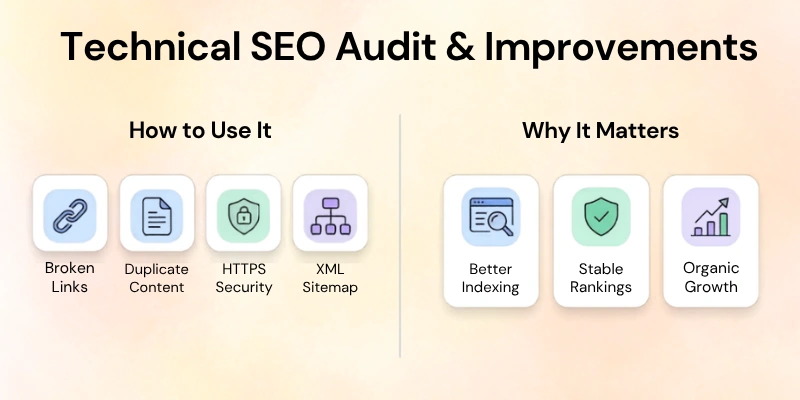
A technical SEO audit checks your website for hidden issues that can stop search engines from crawling or ranking your pages. Fixing these problems ensures your content can reach more people.
How to use it effectively:
- Check for broken links and fix or remove them.
- Resolve duplicate content issues to avoid confusion for search engines.
- Make sure your site uses HTTPS for security.
- Submit an XML sitemap to help search engines discover your pages.
- Implement structured data (schema) to make your content easier to understand.
- Monitor crawl errors regularly and fix any problems.
Why this matters for organic traffic:
- Ensures search engines can index your pages properly.
- Prevents technical issues from blocking your rankings.
- Supports long-term, stable growth in organic traffic.
Page Experience, Mobile & Accessibility
How your website feels to visitors affects whether they stay, return, or leave. A smooth, accessible experience helps people interact with your content easily.
How to use it effectively:
- Make sure your pages load quickly to prevent users from leaving.
- Ensure your site works well on all devices, especially smartphones.
- Use readable fonts, clear layouts, and contrasting colours.
- Add alt text and captions so everyone, including people with disabilities, can access your content.
- Avoid intrusive pop-ups or ads that block content.
Why this matters for organic traffic:
- Better user experience encourages longer visits and repeat traffic.
- Satisfying user behaviour signals to search engines that your site is valuable.
- Improves overall accessibility, reaching a wider audience naturally.
Build Internal and External Links
Links help people navigate your site and show search engines that your content is trustworthy. Proper linking can bring more visitors and improve your rankings.
How to use it effectively:
- Connect related pages on your own website using internal links.
- Add links to older content where relevant to guide readers deeper into your site.
- Earn backlinks from other reputable websites through guest posts, collaborations, or resource sharing.
- Share useful content that naturally encourages other sites to link to you.
- Avoid low-quality or spammy links that can harm your rankings.
Why this matters for organic traffic:
- Internal links keep visitors exploring more pages, increasing engagement.
- External links boost your website’s credibility, helping it rank higher.
- Well-linked content can attract referral traffic from other sites.
Optimize for Featured Snippets and AI-Powered Search
Featured snippets are the highlighted answers that appear at the top of search results, and AI-powered results are becoming more common. Targeting these can give your content prime visibility.
How to use it effectively:
- Provide concise answers to common questions in your content.
- Use bullet points, numbered lists, or tables for clarity.
- Add an FAQ section with clear, direct answers.
- Focus on demonstrating expertise and trustworthiness in your content.
- Structure headings and content logically so search engines can easily understand it.
Why this matters for organic traffic:
- Captures attention at the top of search results, increasing clicks.
- Helps your content reach people using AI-driven search features.
- Position your site as an authoritative source in your niche.
Promote Your Content
Creating great content is just the first step. Sharing it strategically helps more people discover it and boosts your organic traffic naturally.
How to use it effectively:
- Share your articles on social media channels where your audience is active.
- Send your content to subscribers through email newsletters.
- Participate in relevant forums or communities and link to your content when helpful.
- Repurpose content into videos, infographics, or slides to reach different audiences.
- Encourage readers to share your content with their networks.
Why this matters for organic traffic:
- Increases visibility beyond search engines.
- Attracts new visitors who may link to your content later.
- Drives consistent traffic growth by reaching more people naturally.
Refresh & Repurpose Old Content
Updating and repurposing your existing content keeps it relevant and continues to attract visitors over time. This strategy helps maintain and grow your organic traffic without always creating new content.
How to use it effectively:
- Review older posts and update outdated information or statistics.
- Add new examples, tips, or insights to make content more valuable.
- Turn written content into other formats like videos, infographics, slides, or social posts.
- Combine several related posts into a comprehensive guide for more in-depth coverage.
- Remove content that is no longer useful or merge it with better-performing pages.
Why this matters for organic traffic:
- Keeps your content fresh, improving its ranking in search results.
- Attracts returning visitors and encourages shares.
- Maximizes the value of existing content with minimal effort.
Measure, Analyze, and Improve
Tracking how your content performs helps you see what works and what doesn’t. Using this data allows you to make smarter decisions to grow organic traffic over time.
How to use it effectively:
- Use Google Analytics and Google Search Console to monitor traffic, clicks, and user behaviour.
- Identify which pages get the most visits and engagement.
- Check which keywords are driving traffic and find opportunities to optimize.
- Experiment with changes like updating titles, adding visuals, or improving content structure.
- Track progress over time to see which strategies bring the best results.
Why this matters for organic traffic:
- Helps you focus on actions that truly increase visitors.
- Prevents wasted effort on strategies that don’t work.
- Supports continuous improvement for long-term growth.
Wrapping Up
In this guide, we have covered how to increase website traffic organically. While organic strategies are powerful, they do come with limitations, such as slower results compared to paid campaigns and the need for continuous effort.
My personal recommendation is to balance patience with consistent action—plan your content, monitor results, and adjust strategies regularly to manage these risks effectively.
Thank you for taking the time to read this guide. I hope you found it useful and easy to follow. If you have any questions, feel free to ask me in the comments—I’ll be happy to help.
FAQs: How to Drive Organic Traffic to Your Website
Here are some of the most common questions people ask when trying to grow their website traffic naturally. These answers will help you understand strategies better and avoid common mistakes:
The 80/20 rule in SEO means that 20% of your efforts produce 80% of your results. By focusing on the most important pages and high-value keywords, you can maximize your growth. These are your website traffic increase tips that give the biggest impact with the least effort.
Yes, SEO traffic is a type of organic traffic. It comes from people finding your website naturally through search engines, not paid ads. Optimizing your site for SEO helps increase this organic traffic and shows that your content is valuable to users.
A score of 75 is average, meaning your website is fairly well-optimized but still has room to improve. It’s a good starting point, but fixing the remaining SEO issues can help boost rankings. Improving these areas can also support better website traffic increase tips.
Getting 100% SEO means making your website fully optimized for search engines. Focus on technical SEO like fast load times, optimized images, and browser caching. Also, create high-quality content and fix SEO issues to improve the website traffic steadily.
In 2026, websites should ideally load in under two seconds. Fast-loading pages improve search rankings, user experience, and conversions. Anything slower increases bounce rates and reduces the chances of improving the website traffic naturally.
Both Domain Authority (DA) and Domain Rating (DR) are useful, but the focus depends on your goal. If backlinks matter most, DR shows the strength of your site’s link profile. This helps you plan website traffic increase tips that target high-quality referral traffic.
Yes, using relevant keywords helps search engines understand your content. Include them naturally in titles, headings, and text. Proper keyword use is one of the easiest ways to improve website traffic without spending on ads.
Focus on SEO, updating old content, and creating helpful blog posts. Use internal linking and encourage sharing on social media. These steps are practical ways to improve the website traffic organically and sustainably.




- Be Respectful
- Stay Relevant
- Stay Positive
- True Feedback
- Encourage Discussion
- Avoid Spamming
- No Fake News
- Don't Copy-Paste
- No Personal Attacks
- Be Respectful
- Stay Relevant
- Stay Positive
- True Feedback
- Encourage Discussion
- Avoid Spamming
- No Fake News
- Don't Copy-Paste
- No Personal Attacks
