Advantages and Disadvantages of Programmatic Advertising
Published: 23 Apr 2026
Many businesses waste time and money on ads that do not bring good results. This often happens because they do not fully understand the advantages and disadvantages of programmatic advertising.
While this method can improve targeting and save time, it can also create problems like complexity and lack of control if not used properly. Marketers often feel stuck when results do not match expectations.
In this article, we will explain both the advantages and disadvantages in simple terms so you can avoid mistakes and make better advertising decisions for your business.
Let’s begin!!!
Advantages of Programmatic Advertising
Programmatic advertising is very useful for modern businesses. It helps brands run ads in a faster and smarter way. You do not need to do everything by hand. This makes the whole process simple and smooth.
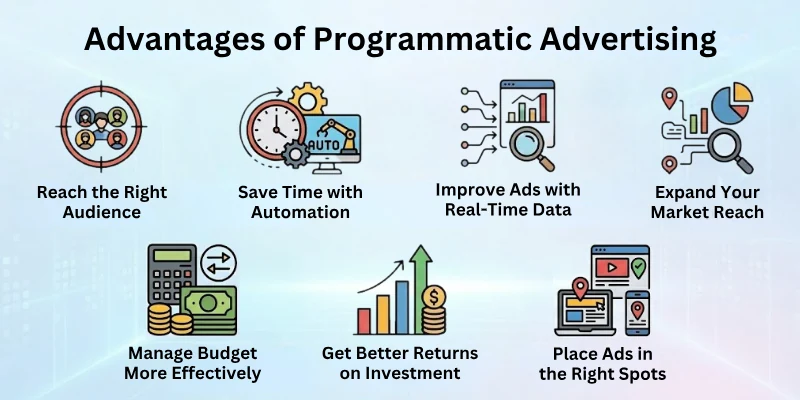
Here is the list of benefits of programmatic advertising.
- Reach the Right Audience
- Save Time with Automation
- Improve Ads with Real-Time Data
- Expand Your Market Reach
- Manage Budget More Effectively
- Get Better Returns on Investment
- Place Ads in the Right Spots
Let’s cover programmatic advertising advantages in detail.
1. Reach the Right Audience
Programmatic advertising helps you show ads to people who are more interested. The system uses data like age, location, and user behaviour. This means your ads reach the right group instead of random users. For example, a clothing brand can target people who like fashion.
This makes your ads more useful for viewers. People see ads that match their needs. It also improves trust because users feel the ads are relevant. As a result, your message becomes more effective.
Smart Tips:
- Define your audience clearly
- Use interest-based targeting
- Try different audience groups
- Avoid targeting everyone
- Update audience data often
2. Save Time with Automation
Programmatic advertising works automatically. You do not need to contact websites or manage ads one by one. The system handles buying and placing ads quickly. This saves a lot of time and effort.
You can focus on planning and strategy. For example, a small business owner can run ads while doing other work. The system manages the process in the background.
Smart Tips:
- Set clear goals before starting
- Use simple campaign settings
- Check performance daily
- Avoid making too many changes
- Choose trusted platforms
3. Improve Ads with Real-Time Data
You can see how your ads perform instantly. Programmatic advertising gives you live updates. If an ad is not working, you can fix it quickly. This helps you improve results over time.
You also learn what your audience likes. For example, you can test two ads and keep the better one. This makes your campaigns stronger and smarter.
Smart Tips:
- Monitor campaigns daily
- Pause weak ads quickly
- Test different ad styles
- Focus on high-performing ads
- Use simple reports
4. Expand Your Market Reach
Programmatic advertising helps you reach more people. Your ads can appear on many websites and apps. This increases your visibility and brand awareness.
For example, your ad can show on blogs, apps, and news sites at the same time. This helps you connect with a larger audience. You can also reach users in different locations easily.
Smart Tips:
- Use multiple platforms
- Target both mobile and desktop users
- Focus on popular sites
- Adjust reach based on goals
- Avoid showing ads too often
5. Manage Budget More Effectively
You can control how much money you spend. Programmatic advertising allows you to set a budget limit. The system uses your budget wisely and avoids waste.
This is helpful for small businesses. For example, you can start with a small budget and grow slowly. You only pay for useful actions like clicks or views.
Smart Tips:
- Set daily spending limits
- Start with a small budget
- Track your spending
- Stop low-performing ads
- Focus on valuable results
6. Get Better Returns on Investment
Programmatic advertising helps you get more value from your money. It targets the right audience and improves ad performance. This increases your chances of getting good results.
For example, when the right people see your ad, they are more likely to take action. This improves your overall return. Over time, your campaigns become more profitable.
Smart Tips:
- Track conversions regularly
- Focus on quality traffic
- Improve ads based on results
- Avoid random targeting
- Set clear campaign goals
7. Place Ads in the Right Spots
Programmatic advertising chooses the best places for your ads. It matches your ads with relevant websites and apps. This increases the chances that users will notice them.
For example, a food brand can place ads on cooking websites. This makes the ad more useful and engaging. Good placement helps improve visibility and results.
Smart Tips:
- Choose relevant platforms
- Avoid low-quality sites
- Test different placements
- Monitor ad locations
- Focus on user-friendly websites
Disadvantages of Programmatic Advertising
Programmatic advertising also has some downsides. It is not always easy to manage, especially for beginners. You need to understand how the system works before you get good results.
Some problems can also affect your budget and performance. If you do not manage it well, you may waste money. That is why it is important to know the risks before you start.
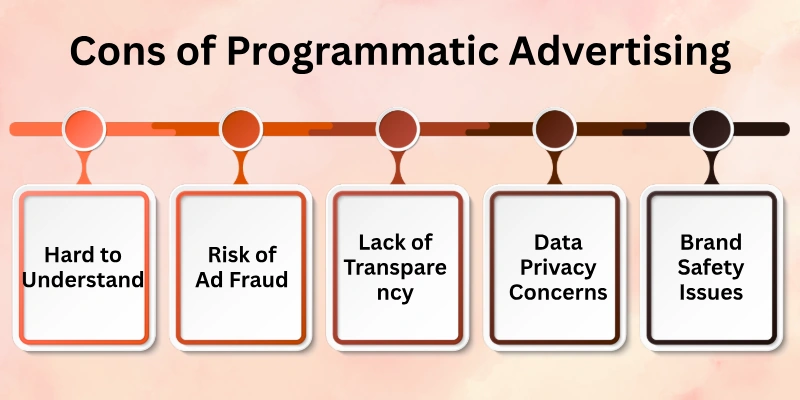
Let’s look at some common challenges of programmatic advertising.
- Hard to Understand for Beginners
- Risk of Ad Fraud
- Limited Control Over Ad Placement
- Data Privacy Concerns
- Lack of Transparency
- Dependence on Technology
- Brand Safety Issues
Let’s explore the cons of programmatic advertising in detail.
1. Hard to Understand for Beginners
Programmatic advertising can feel confusing at first. It uses many tools, terms, and systems. New users may find it hard to set up campaigns correctly. For example, things like bidding and targeting can be tricky.
This confusion can lead to mistakes. You may choose the wrong settings or audience. As a result, your ads may not perform well. Beginners often need time to learn and practice.
Smart Tips:
- Start with basic campaigns
- Learn simple terms first
- Use beginner-friendly platforms
- Watch tutorials before starting
- Take small steps and learn slowly
2. Risk of Ad Fraud
Ad fraud is a big problem in programmatic advertising. Sometimes fake clicks or fake traffic can waste your money. Bots may click on your ads instead of real people. This means you pay but get no real results.
This can affect your campaign performance. You may think your ads are working, but they are not. For example, a business may lose money without gaining real customers.
Smart Tips:
- Use trusted ad platforms
- Monitor traffic quality
- Avoid unknown websites
- Check reports regularly
- Use fraud detection tools
3. Limited Control Over Ad Placement
You do not always control where your ads appear. The system decides the placement based on data. Sometimes your ads may show on websites that are not suitable.
This can harm your brand image. For example, your ad may appear on low-quality or unrelated sites. This reduces trust and can affect your results.
Smart Tips:
- Use placement filters
- Block unwanted websites
- Review placement reports
- Choose premium platforms
- Monitor ads regularly
4. Data Privacy Concerns
Programmatic advertising uses user data to target ads. This includes location, interests, and behaviour. Some users feel uncomfortable with this data use.
There are also strict privacy rules in many countries. If you do not follow them, you may face problems. For example, misuse of data can damage your brand reputation.
Smart Tips:
- Follow data privacy rules
- Be transparent with users
- Avoid collecting extra data
- Use secure platforms
- Respect user consent
5. Lack of Transparency
Sometimes it is hard to see where your money goes. Programmatic advertising systems are complex. You may not fully understand how ads are placed or priced.
This lack of clarity can create confusion. For example, you may not know why a campaign is not performing well. This makes it harder to improve results.
Smart Tips:
- Use clear reporting tools
- Ask for detailed insights
- Track key metrics
- Avoid unknown networks
- Work with trusted partners
6. Dependence on Technology
Programmatic advertising depends fully on technology. If the system fails, your ads may stop running. Technical issues can affect your campaigns.
You also need the internet and tools to manage everything. For example, a system error can delay your ads. This can impact your marketing plans.
Smart Tips:
- Use reliable platforms
- Keep backup plans ready
- Check systems regularly
- Update tools when needed
- Stay informed about issues
7. Brand Safety Issues
Your ads may appear next to harmful or negative content. This can damage your brand image. For example, your ad may show on a site with inappropriate content.
This can reduce customer trust. People may connect your brand with that content. It is important to protect your brand image at all times.
Smart Tips:
- Use brand safety filters
- Block risky categories
- Monitor ad placements
- Choose trusted publishers
- Review campaigns often
Pros and Cons of Programmatic Advertising (Summary Table)
Here is a simple and easy table to understand both sides:
| Pros | Cons |
| Fast automation | Complex system |
| Better targeting | Privacy issues |
| Wide reach | Ad fraud risk |
| Real-time updates | Less control |
When Should You Use Programmatic Advertising?
Programmatic advertising works best when you want fast and smart ad results. It helps you reach the right people without wasting time on manual work. Many businesses use it when they want better control over targeting and performance.
You should use it when your marketing goals need speed, accuracy, and wide reach.
- You want to reach a large and specific audience quickly
- You need to run ads across many websites and apps
- You want real-time tracking and performance updates
- You have a clear advertising goal or campaign plan
- You want to improve ad results using data and insights
- You are managing a medium or large marketing budget
- You want to scale your ads without manual effort
- You need better targeting than traditional advertising methods
Conclusion
In this article, we have covered the pros and cons of programmatic advertising in a simple and beginner-friendly way. We looked at how it works, its main benefits, and the challenges that come with it.
Overall, programmatic advertising is a smart tool for modern businesses. It helps improve speed, targeting, and performance, but it also needs careful use to avoid problems like ad fraud and low transparency.
Don’t skip the next part of the FAQs. You may find extra helpful details about the advantages and disadvantages of programmatic advertising that can make your understanding even stronger. If you miss it, you could miss something really valuable.
FAQs on Pros and Cons of Programmatic Advertising
Here are some common questions people ask about programmatic advertising, its benefits, and its drawbacks. These answers will help you understand how it works in simple words.
Programmatic advertising offers many benefits for digital marketers and businesses. It improves targeting, saves time, and increases campaign performance. It is widely used in digital marketing for better ad results.
Yes, programmatic advertising for small businesses can be very useful. It allows them to target specific audiences even with a low budget. However, beginners should start small and learn how programmatic ad platforms work.
Real-time bidding (RTB) is a key part of programmatic advertising. It means ad space is sold in an instant auction when a user visits a website. The highest and most relevant bid wins and shows the ad immediately.
Programmatic advertising comes with some risks in digital marketing. These risks can affect campaign performance if not managed properly.
- Ad fraud from fake clicks or bot traffic
- Poor ad placement on irrelevant websites
- Data privacy concerns in targeted advertising
Programmatic advertising is important because it improves online advertising efficiency. It helps marketers reach the right audience using data-driven strategies. This leads to better engagement and improved marketing results.
Programmatic advertising uses automation, AI, and real-time data for ad buying. Traditional advertising depends on manual processes and direct media buying. Programmatic advertising is faster, more targeted, and more flexible.
Yes, programmatic advertising can improve ROI when used correctly. It reduces wasted ad spend by targeting the right users. This results in better conversions and improved return on investment.




- Be Respectful
- Stay Relevant
- Stay Positive
- True Feedback
- Encourage Discussion
- Avoid Spamming
- No Fake News
- Don't Copy-Paste
- No Personal Attacks
- Be Respectful
- Stay Relevant
- Stay Positive
- True Feedback
- Encourage Discussion
- Avoid Spamming
- No Fake News
- Don't Copy-Paste
- No Personal Attacks
