Advantages and Disadvantages of A/B Testing in 2026
Published: 6 Aug 2026
Are you unsure why some website changes work while others fail? A/B testing can solve this mystery. It helps you test two versions and find out which one performs better.
Here, we will cover the advantages and disadvantages of A/B testing. You’ll discover advantages like improved user experience and actionable insights, plus disadvantages like limited testing scope and setup risks.
By the end, you’ll know how to use A/B testing the right way.
Benefits of A/B Testing
A/B testing helps businesses and website owners find out what works best by comparing two versions and seeing which one performs better.
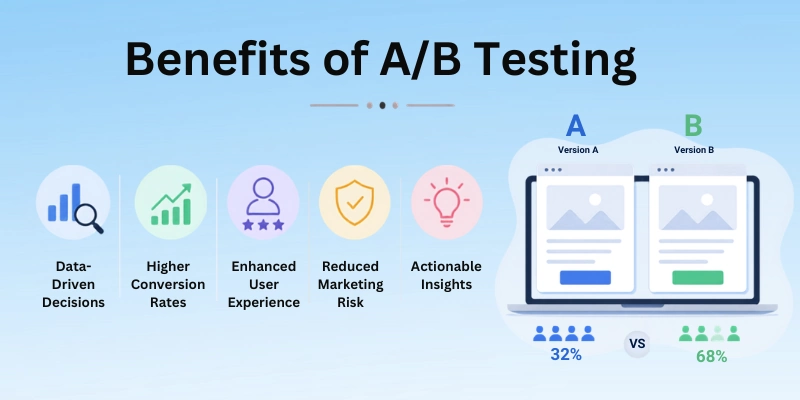
Here is the list of advantages of a/b testing:
- Data‑Driven Decisions
- Higher Conversion Rates
- Enhanced User Experience
- Reduced Marketing Risk
- Actionable Insights
Let’s explore them in detail.
1. Data‑Driven Decisions
A/B testing helps you make decisions based on real data, not guesses. You can see how visitors react to different versions of your page, email, or ad. This means you choose the option that actually works best. It reduces mistakes and wasted effort.
Businesses can focus on changes that bring real results. Over time, these data-driven choices improve overall performance. You can trust the results because they come from actual user behaviour.
2. Higher Conversion Rates
A/B testing can increase conversions, like clicks, sign-ups, or sales. By testing small changes, you find what encourages visitors to act. Even tiny tweaks, like button colour or headline text, can make a big difference.
Higher conversions mean more success without spending more on ads. This helps your website or business grow steadily. You can measure which version brings the most results. It ensures your efforts are focused on strategies that work.
3. Enhanced User Experience
Testing different versions helps improve the experience for visitors. You can see what layout, text, or design they like best. A better experience keeps users happy and engaged. Happy users are more likely to return or buy from you.
It also builds trust in your brand. A/B testing allows small improvements that add up over time. You can give users exactly what they want, making your site easier to use.
4. Reduced Marketing Risk
A/B testing lowers the risk of making big changes that might fail. Instead of changing a whole page at once, you test small parts first. If one version doesn’t work, the impact is minimal. This makes your marketing safer and smarter.
You learn from mistakes before they become costly. Businesses can experiment confidently. It gives a controlled way to try new ideas.
5. Actionable Insights
A/B testing gives clear information you can use to improve results. You see which elements perform better and why. These insights help with future campaigns or website changes. They show trends in user behaviour over time.
You can apply what you learn to other parts of your site or business. It turns testing into a learning process. Insights from A/B testing make your decisions stronger and more effective.
Disadvantages of A/B Testing
Although A/B testing is helpful, it also has some drawbacks that can make it tricky for businesses to get perfect results every time.
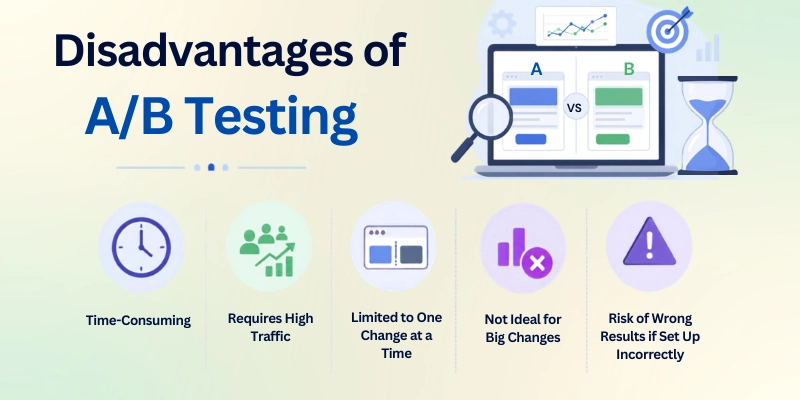
Here is the list of cons of a/b testing:
- Time‑Consuming
- Requires High Traffic
- Limited to One Change at a Time
- Risk of Wrong Results if Set Up Incorrectly
- Not Ideal for Big Changes
Let’s analyze them in detail.
1. Time‑Consuming Process
A/B testing can take a lot of time to plan and run. You need to create different versions of your page, email, or ad. Then, you must wait for enough visitors to see each version. Analyzing results also takes extra time.
Small websites with low traffic may wait weeks for meaningful data. For busy teams, this can slow down other work. While results are useful, the process itself can feel slow.
2. Requires High Traffic
A/B testing works best when many people visit your site. If traffic is low, results may be unclear or inaccurate. Small sample sizes can give false results. You might think one version is better when it isn’t.
This makes it hard for small businesses to rely on testing. Without enough users, the data may not represent real behaviour. High traffic is needed to make confident decisions.
3. Limited to One Change at a Time
A/B testing tests one element at a time, like a headline or button colour. Testing multiple changes at once can confuse results. This means you can’t fix everything in one go. It slows down large redesigns or big campaigns.
You must prioritize what to test first. Sometimes small changes take longer to show an overall impact. Testing multiple changes separately is more complicated but necessary.
4. Risk of Wrong Results if Set Up Incorrectly
A/B testing needs careful setup to be accurate. If tracking, audience split, or timing is wrong, results can mislead you. This can lead to wrong business decisions. Even small mistakes in data collection affect conclusions.
Many beginners make setup errors without realizing it. Testing tools must be used correctly. Accurate setup is essential to get reliable insights.
5. Not Ideal for Big Changes
A/B testing works best for small improvements, not large changes. Big redesigns or new products may need a different approach. Testing tiny elements may not show the full picture. Relying only on A/B testing could limit innovation.
Some changes require user research or other methods. It’s important to know when testing is useful and when it’s not. A/B testing is a tool, not a solution for everything.
When to Use A/B Testing (Practical Tips)
A/B testing works best when you want to improve your website, email, or ads step by step. It helps you make decisions based on real data instead of guessing. Here are some practical situations to use A/B testing:
- Test different headlines or titles to see which attracts more visitors.
- Try two versions of call-to-action buttons to increase clicks.
- Compare images or videos to find which one engages users better.
- Test email subject lines to improve open rates.
- Experiment with page layouts to boost conversions.
- Use A/B testing before making big website or marketing changes.
Common A/B Testing Mistakes to Avoid
A/B testing is helpful, but beginners often make mistakes that affect results. Knowing these mistakes can save time and give more accurate insights. Here are some common errors to watch out for:
- Testing too many things at once – Focus on one change at a time to know what really works.
- Ending the test too soon – Make sure enough visitors see both versions before deciding the winner.
- Not checking data carefully – Always review your results to avoid wrong conclusions.
Final Words
In this guide, we have covered the pros and cons of A/B testing. While A/B testing brings clear benefits like higher conversions, better user experience, and data-driven decisions, it also comes with limitations such as time requirements, traffic needs, and setup risks.
To balance these, start with small tests, track results carefully, and apply insights gradually. By managing the process thoughtfully, you can enjoy the advantages while minimizing potential drawbacks.
Thank you for reading this guide. I hope it helped you understand A/B testing better and gave you practical ideas to use it successfully.
Explore the next FAQ section; you may find surprising tips, so make sure you don’t skip it.
FAQs: Pros and Cons of A/B Testing
Here are some common questions about the advantages and disadvantages of A/B testing to help you understand it better:
Yes, A/B testing is designed to help increase your website’s conversion rate. By trying two different versions, you learn which version gets more clicks, sales, or sign‑ups. This makes your pages work better over time.
A/B testing itself does not hurt SEO if done correctly. You should avoid showing very different content that search engines might see as duplicate. Using best practices keeps your SEO safe while testing.
Small websites with low traffic may not see clear A/B testing results. You need enough visitors to show both versions to enough people. If traffic is low, it can take a long time to get meaningful data.
A/B testing compares two versions of one element at a time. Multivariate testing compares many elements at once. Multivariate testing needs much more traffic and complexity.
Results can be unclear if you don’t have enough traffic or if the changes are too small. Ending the test too soon or testing many things at once can also lead to unclear results. Good planning helps get clear answers.
Start by testing high‑impact elements like headlines, call‑to‑action buttons, or images. These usually affect user behaviour more than small changes. Focus on big differences to see clearer results




- Be Respectful
- Stay Relevant
- Stay Positive
- True Feedback
- Encourage Discussion
- Avoid Spamming
- No Fake News
- Don't Copy-Paste
- No Personal Attacks
- Be Respectful
- Stay Relevant
- Stay Positive
- True Feedback
- Encourage Discussion
- Avoid Spamming
- No Fake News
- Don't Copy-Paste
- No Personal Attacks
