Trending Types of Marketing Funnels in 2026
Published: 30 Aug 2026
Marketing has changed a lot in the digital world, and people now behave in different ways online every day. Types of marketing funnels help businesses understand how to guide users from the first interaction to the final purchase.
From awareness to buying, every step plays an important role in shaping a customer’s decision. Without a clear structure, marketing often feels messy and does not bring strong results.
That is why learning different funnel types is important for every marketer and business owner.
In this article, you will learn the main types of marketing funnels and how they can make the customer journey smooth and effective.
Types of Marketing Funnels
Marketing funnels help you understand how people move from first seeing your brand to finally making a purchase. Different funnel types work for different goals, like sales, leads, or brand awareness.
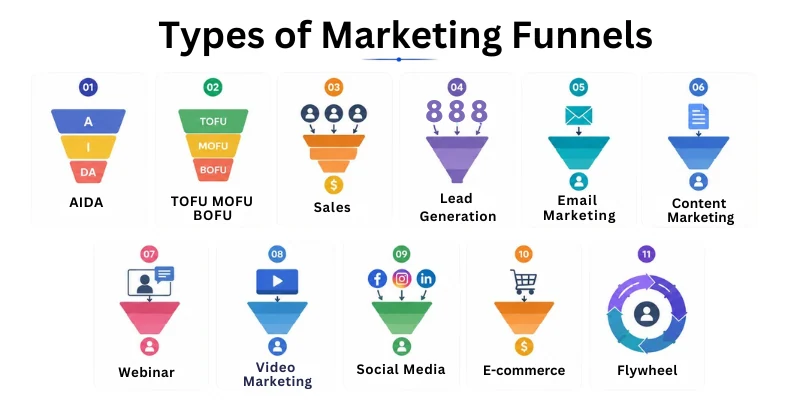
Here are the most commonly used types of marketing funnels in digital marketing:
- AIDA Funnel
- TOFU MOFU BOFU Funnel
- Sales Funnel
- Lead Generation Funnel
- Email Marketing Funnel
- Content Marketing Funnel
- Webinar Funnel
- Video Marketing Funnel
- Social Media Funnel
- E-commerce Funnel
- Flywheel Funnel
Let’s analyze them in detail.
1. AIDA Funnel
The AIDA funnel is one of the oldest and most trusted marketing models. It explains how a person moves from first seeing your brand to finally making a purchase. It follows four simple steps: Awareness, Interest, Desire, and Action.
In real marketing, this funnel helps you guide users step by step. You first grab attention, then build interest, create need, and finally ask for action, like buying or signing up.
- It works well for ads and landing pages
- Helps you write clear marketing messages
- Easy for beginners to understand and use
- Strong for guiding first-time buyers
2. TOFU, MOFU, BOFU Funnel
This funnel divides the customer journey into three parts. TOFU means Top of Funnel, where people just discover your brand. MOFU is the Middle of Funnel, where they compare and learn more. BOFU is the Bottom of Funnel, where they decide to buy.
Marketers use this model to create the right content for each stage. It helps you speak to people based on what they need at that moment, not randomly.
- TOFU builds awareness with blogs and posts
- MOFU builds trust with guides and comparisons
- BOFU focuses on offers and sales pages
- Helps organize content strategy clearly
3. Sales Funnel
A sales funnel focuses on one goal: turning visitors into paying customers. It starts when someone visits your page and ends when they complete a purchase.
Businesses use this funnel to remove confusion and guide users smoothly. Every step is designed to reduce doubt and increase trust until the user is ready to buy.
- Used in online stores and service websites
- Helps improve conversion rates
- Focuses only on buying decisions
- Works best with strong offers and landing pages
4. Lead Generation Funnel
This funnel is used to collect contact details like emails or phone numbers. Instead of selling directly, it first builds a list of interested users.
Marketers use free offers like ebooks, checklists, or signups to attract users. Later, they turn these leads into customers through follow-ups.
- Helps build an email or contact list
- Uses free value to attract users
- Important for long-term marketing
- Supports future sales campaigns
5. Email Marketing Funnel
This funnel uses emails to build trust and guide users toward buying. It starts with a welcome email and slowly builds a relationship through useful messages.
Businesses use it to stay connected with users who are already interested. Over time, emails turn cold leads into active customers.
- Builds strong customer relationships
- Works well for repeat sales
- Uses automated email sequences
- Keeps your brand in front of users
6. Content Marketing Funnel
This funnel uses blogs, videos, and guides to attract and educate users. Instead of direct selling, it focuses on giving value first.
When users trust your content, they naturally move toward your product or service. It is one of the strongest ways to get organic traffic.
- Drives traffic through helpful content
- Builds trust before selling
- Works well with SEO strategies
- Attracts users without paid ads
7. Webinar Funnel
A webinar funnel uses live or recorded sessions to explain and sell a product. Users first register, attend the session, and then receive an offer.
It works because people learn first and buy later. Webinars help build strong trust in a short time.
- Best for courses and coaching
- Builds authority quickly
- Converts warm leads into buyers
- Works well for high-value offers
8. Video Marketing Funnel
This funnel uses videos to attract attention and guide users toward action. It starts with short videos that create interest and moves toward deeper content.
Videos make it easier for people to understand your message. That is why this funnel works very well on social media.
- Great for platforms like YouTube and TikTok
- Builds emotional connection fast
- Easy to explain complex ideas
- Increases engagement and reach
9. Social Media Funnel
This funnel turns social media followers into customers. It starts with posts and ends with a sale through messages or links.
It works by building daily engagement with your audience. Over time, people trust your brand and take action.
- Builds audience through posts and stories
- Uses engagement to build trust
- Converts followers into buyers
- Works well for small businesses
10. E-commerce Funnel
This funnel is used on online shopping websites. It tracks the user journey from viewing a product to completing a purchase.
Each step is designed to reduce drop-offs and improve checkout success. Small improvements in this funnel can significantly increase sales.
- Used in Shopify and online stores
- Focuses on the product-to-purchase journey
- Reduces cart abandonment
- Improves checkout experience
11. Flywheel Funnel
The flywheel model focuses on customer experience instead of a one-time sale. It attracts users, engages them, and keeps them happy.
Happy customers bring more customers. This makes the growth cycle continuous and strong.
- Focuses on customer satisfaction
- Encourages repeat business
- Works like a growth cycle
- Builds long-term brand loyalty
Benefits of Using Different Types of Marketing Funnels
Marketing funnels help you understand how people move from learning about your brand to becoming your customer. By using different types of funnels, you can guide users more simply and clearly.
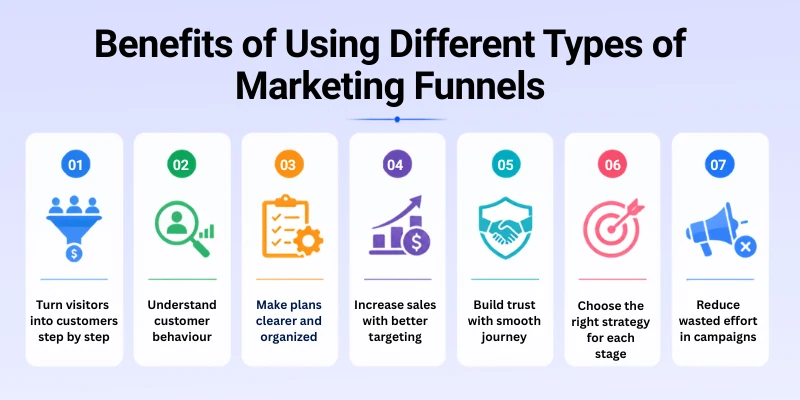
This makes your marketing more focused and effective.
- Helps turn visitors into real customers step by step
- Improves understanding of customer behaviour
- Makes marketing plans clearer and more organized
- Increases sales with better targeting
- Builds trust through a smooth user journey
- Helps you choose the right strategy for each stage
- Reduces wasted effort in marketing campaigns
Common Mistakes in Marketing Funnels
Marketing funnels work well when you build them clearly and simply. But many people make small mistakes that reduce results.
These mistakes often confuse users and stop them from moving forward in the journey.
- Targeting the wrong audience and attracting uninterested people
- Making the funnel too complex instead of keeping it simple
- Not guiding users clearly from one step to the next
- Ignoring follow-ups like emails or messages after the first contact
- Using weak or unclear call-to-action buttons
- Not testing and improving funnel performance over time
- Focusing only on selling instead of building trust first
Conclusion
So guys, it’s time to conclude. In this article, we’ve covered Types of Marketing Funnels in detail. From basic models to advanced funnel strategies, you now have a clear idea of how each funnel works in real marketing.
From my experience, I recommend beginners start with simple funnels like AIDA and lead generation. These are easy to understand and give quick results when applied correctly.
If you found this helpful, start building your first funnel today and see how it improves your marketing results.
FAQs About Types of Marketing Funnels
After learning about different types of marketing funnels, readers often have more questions about how they work in real situations. Here are some simple answers to help you understand things better:
Different funnel types in digital marketing focus on different goals like sales, leads, or brand awareness. Some funnels help you get traffic, while others help you convert that traffic into buyers. Each type works at a different stage of the customer journey.
For example, lead funnels collect emails, while sales funnels focus on buying decisions. Content funnels build trust before selling anything. Both work together in a complete strategy.
The best types of sales funnels for beginners are simple ones like AIDA and basic sales funnels. These are easy to understand and do not need advanced tools. They help you learn how customers move step by step.
- AIDA funnel for simple structure
- Basic landing page funnel
- Email follow-up funnel
Marketing funnel types are important because they help businesses understand customer behaviour. They show how people think before buying a product. This makes marketing more focused and effective.
They also reduce wasted effort in ads and content. Businesses can target the right people at the right time. This improves overall conversion rates.
A sales funnel works by guiding a person from interest to purchase in small steps. First, the user sees an ad or post. Then they visit a page and finally make a purchase.
It removes confusion by giving clear actions at each step. This makes it easier for users to decide. It also increases the chances of completing a sale.
The easiest funnel type to start with is the lead generation funnel. It simply collects user information like email or phone number. You can start with a free offer like an ebook or guide.
This funnel is simple and beginner-friendly. It does not need complex setup. It is great for building an audience first.
Funnel types improve conversion rate by guiding users step by step instead of showing everything at once. This makes the buying process smooth and easy. Users feel more confident when they understand each stage.
It also helps businesses fix weak points in the journey. For example, improving landing pages or emails. Small changes can lead to higher sales.
You can choose the right funnel type based on your goal. If you want leads, use a lead generation funnel. If you want sales, use a sales funnel.
First, understand your audience and what they need. Then match the funnel to your goal. This makes your strategy more effective and clear.


- Be Respectful
- Stay Relevant
- Stay Positive
- True Feedback
- Encourage Discussion
- Avoid Spamming
- No Fake News
- Don't Copy-Paste
- No Personal Attacks
- Be Respectful
- Stay Relevant
- Stay Positive
- True Feedback
- Encourage Discussion
- Avoid Spamming
- No Fake News
- Don't Copy-Paste
- No Personal Attacks
