What are the Advantages and Disadvantages of Digital Marketing?
Published: 14 Jan 2026
Did you know that over 70% of businesses today use the internet to reach customers? Digital marketing is the way companies promote their products or services online through social media, search engines, emails, and ads. It can help you reach more people, save money, and grow your brand faster than traditional methods.
In this article, we will explore the advantages & disadvantages of digital marketing in simple terms, show how it can help your business, and offer tips for using it effectively.
Let’s break down the benefits and challenges so you can make the best choices for your business.
Advantages of Digital Marketing
Digital marketing comes with many benefits that help businesses grow and reach more customers. These benefits allow businesses to connect with the right people and get results faster.
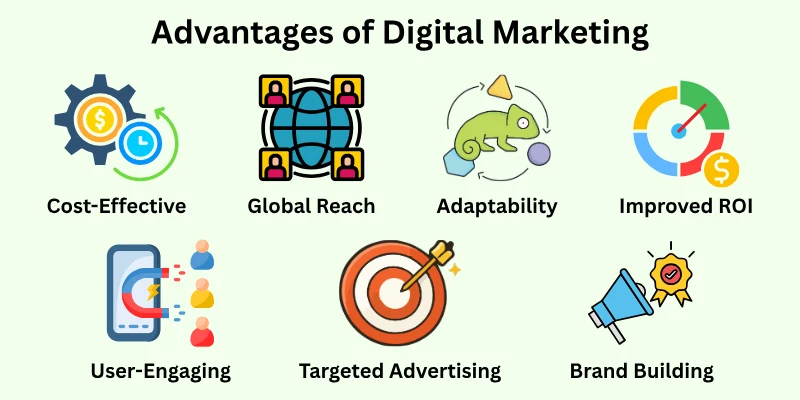
Let’s explore the main pros of digital marketing that make it so powerful.
- Cost-Effective
- Global Reach
- Targeted Advertising
- Measurable Results
- Adaptability
- Enhanced Customer Engagement
- Brand Building & Reputation Management
- Improved Market Analysis
- Improved ROI
- Unintrusive & User-Engaging
- Personalized Messaging
- Professional Website Builders
Let’s cover them in detail.
1. Cost-Effective
Many businesses want to promote their work without spending too much. Online platforms make this easy because you can start with a small budget and still reach a wide audience. This gives new brands a fair chance to grow step by step.
You also stay in control of your money. You can increase or reduce your spending anytime based on your results. This keeps your marketing safe, steady, and smart.
- Saves money compared to old-style ads
- Works even with small budgets
- Allows spending only on winning methods
- Cuts waste and improves value
- Supports steady and safe growth
- Gives strong results with low cost
2. Global Reach
The internet connects you with people from many countries. Your message can appear across different regions at the same time. This gives your brand room to expand faster.
Each region may react differently to your content. You can observe which areas show more interest. This helps you choose better markets for your products.
- Reaches users around the world
- Expands your brand beyond your local area
- Brings traffic from many cultures
- Makes international growth easier
- Helps you discover new markets
- Works for both small and large brands
3. Targeted Advertising
Some groups are more likely to buy your product than others. With targeted ads, you can choose the people who match your ideal customer based on age, area, and interests.
Reaching the right people gives stronger results. You avoid wasting money on the wrong audience. This creates cleaner and more focused campaigns.
- Reaches people who match your product
- Selects age, area, and interests easily
- Reduces money waste
- Improves ad performance
- Brings better-quality leads
- Increases your chance of sales
4. Measurable Results
Numbers show you what is working and what is not. You can see clicks, views, sales, and many other actions. This gives you a clear picture of your audience’s behaviour.
With this information, making smart choices becomes simple. You can keep the methods that work best and change the ones that don’t. This keeps your growth moving in the right direction.
- Shows real-time data
- Tracks user actions clearly
- Supports smart planning
- Highlights the strong and weak points
- Improves future decisions
- Gives proof of progress
5. Adaptability
Trends change fast in today’s world. Online platforms allow quick updates whenever your strategy needs a fresh approach. You can fix problems or follow new ideas without delay.
This gives you more freedom to shape your campaigns. You can respond to market needs in minutes and stay ahead of competitors. It keeps your brand active and ready.
- Allows quick changes
- Supports fresh ideas easily
- Gives full control over your campaigns
- Keeps your strategy flexible
- Helps you react fast to trends
- Reduces the risk of slow updates
6. Enhanced Customer Engagement
Talking with your audience becomes much easier online. People can reply, comment, or react to your content in seconds. This creates a warm and active connection between your brand and your users.
When people feel involved, they trust your brand more. They also share feedback that improves your product and service. This builds long-lasting relationships.
- Creates real-time interaction
- Builds trust through quick responses
- Increases user interest
- Encourages questions and feedback
- Makes your brand feel more human
- Keeps your audience active and connected
7. Brand Building & Reputation Management
A strong online presence helps people understand who you are and what you offer. Your posts, videos, and updates shape your brand’s voice and style. Over time, people begin to recognize and remember you.
Managing your reputation also becomes easier. You can answer reviews, guide unhappy customers, and share helpful content. This builds a positive image and increases respect for your brand.
- Builds trust through regular updates
- Shapes a clear brand identity
- Handles negative reviews quickly
- Shows your brand as active and reliable
- Strengthens long-term loyalty
- Helps your business stand out
8. Improved Market Analysis
Online tools give you clear information about your audience. You can see what they buy, what they search for, and what they enjoy. This makes understanding your market easy.
With this information, you can fine-tune your strategy. You can adjust your products, pricing, or promotions based on real data. This keeps your decisions accurate and timely.
- Shows customer behaviour clearly
- Helps you study trends
- Supports better product planning
- Gives insight into customer needs
- Helps you adjust prices and offers
- Reduces guesswork in decisions
9. Improved ROI
Every business wants better returns from its investment. Online methods make this possible because you reach the right people at the right time. This brings more sales with less spending.
Clear data also guides your next steps. You can invest more in strategies that give strong results. This increases your profit and saves money.
- Increases sales with lower costs
- Shows which campaigns work best
- Reduces wasteful spending
- Maximizes your earnings
- Makes growth faster
- Strengthens your financial results
10. Unintrusive & User-Engaging
People enjoy content that feels natural and friendly. Online channels allow soft and smooth messages that don’t disturb your audience. This makes users more open to your brand.
You can also use fun, creative, and interactive formats. These formats grab attention and keep users interested. This creates a pleasant experience for your audience.
- Feels natural and user-friendly
- Avoids pushing hard messages
- Encourages users to explore more
- Works well with creative content
- Builds positive impressions
- Increases the time people spend with your brand
11. Personalized Messaging
Sending messages that match your audience’s interests makes them feel special. You can address people by name, suggest products they like, or share content they enjoy. This creates a closer connection with users.
Personalized messages also increase the chance of action. People are more likely to click, buy, or respond when the content is relevant to them. This builds loyalty and trust over time.
- Targets messages to individual preferences
- Makes users feel valued
- Improves response rates
- Encourages repeat visits or purchases
- Builds stronger customer relationships
- Increases engagement with content
12. Professional Website Builders
Having a professional-looking website improves your brand image instantly. Tools online make it easy to design a website with no coding knowledge. A clean website attracts more visitors and makes navigation simple.
A good website also supports marketing efforts. You can showcase products, share updates, and collect leads efficiently. This becomes a central hub for your business online.
- Creates a clean and modern look
- Easy to design without coding
- Supports sales and promotions
- Collects customer information
- Works as a brand showcase
- Improves credibility and trust
Disadvantages of Digital Marketing
Digital marketing offers many benefits, but it also has some challenges. Businesses can face problems if strategies are not planned carefully or if trends change too fast.
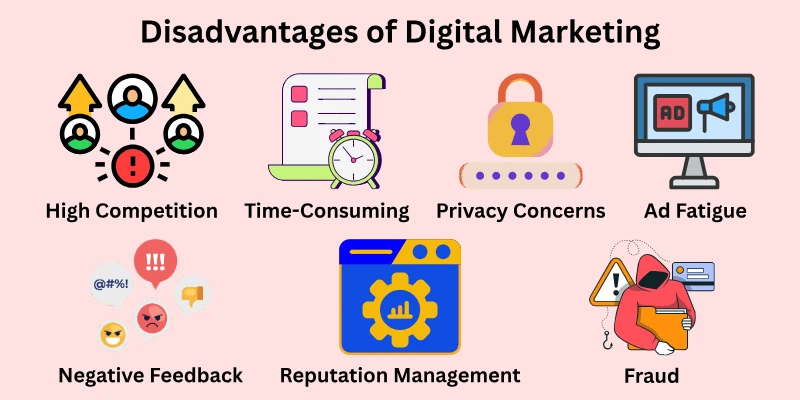
Here is the list of drawbacks of digital marketing:
- High Competition
- Requires Technical Skills
- Security & Privacy Concerns
- Time-Consuming
- Ad Fatigue & Information Overload
- Negative Feedback & Reputation Management
- Potential for Strategy Theft
- Platform Dependency
- Difficulty in Measuring Some Efforts
- Increased Risk of Scams & Fraud
Let’s discuss in detail.
1. High Competition
Many businesses are online, which makes the market crowded. Because so many brands compete for the same audience, it becomes hard for new or small businesses to get noticed.
This high competition may reduce your ad visibility and slow down growth. You need extra effort and creativity to stand out.
- Many brands compete for the same customers
- New businesses may struggle to get attention
- Ads may be ignored due to saturation
- Requires more effort to be noticed
- Can increase marketing costs
- Slows down brand growth
2. Requires Technical Skills
Running campaigns online needs knowledge of tools, software, and analytics. Without these skills, businesses may make mistakes that waste money or time.
This creates a barrier for beginners or small teams. They might need to learn new skills or hire experts to manage campaigns successfully.
- Online tools and software require learning
- Beginners may make mistakes easily
- Tracking results can be confusing
- May need extra training or hiring experts
- Mistakes can waste budget
- Campaigns may fail without proper skills
3. Security & Privacy Concerns
Sharing data online can put sensitive information at risk. If proper security is not used, hackers or leaks can expose customer or business data.
This risk may damage trust and reputation. Businesses must follow rules and use strong protection to avoid problems.
- Risk of hacking and data theft
- Customer privacy may be compromised
- Strong security measures are required
- Losing data can harm brand trust
- Needs constant monitoring
- Legal rules must be followed
4. Time-Consuming
Creating content, running campaigns, and tracking results takes a lot of time. Unorganized businesses may struggle to manage everything efficiently.
This may slow down other work and reduce productivity. Patience and consistent effort are required to see results.
- Campaigns need constant attention
- Content creation takes time
- Small teams may feel overburdened
- Frequent updates are needed
- Success may take longer than expected
5. Ad Fatigue & Information Overload
Users see many ads and information online every day. When people are exposed to too much content, they may start ignoring your ads or feel annoyed.
This reduces interaction and effectiveness. You must create fresh and interesting content to keep attention.
- Users may stop noticing ads
- Too much information overwhelms audiences
- Repeated ads may annoy users
- Creative content is needed constantly
- Frequency must be balanced
6. Negative Feedback & Reputation Management
Online users can leave critical reviews or comments. If businesses ignore these, negative feedback may spread and harm their reputation.
Responding carefully is necessary. Poor management of criticism may reduce trust and brand value.
- Negative reviews affect customer trust
- Unhappy users can share their experiences widely
- Quick responses are required
- Ignoring complaints harms brand image
- Constant monitoring is needed
- Managing reputation takes effort
7. Potential for Strategy Theft
Competitors can see online campaigns and copy strategies or ideas. Unique plans may lose their advantage if duplicated.
This may reduce market edge and profits. Businesses need original ideas and careful planning to stay competitive.
- Competitors can copy campaigns easily
- Original ideas may lose value
- Requires creative and unique content
- Market advantage can decrease
- Monitoring competitors is necessary
- Protecting ideas is important
8. Platform Dependency
Many businesses rely heavily on platforms like Google, Facebook, or Instagram. If these platforms change rules or algorithms, campaigns may be affected.
This dependency can create uncertainty and risks. Businesses should diversify channels to maintain stability.
- Changes in platform rules affect campaigns
- Over-reliance is risky
- Algorithm updates may reduce reach
- Multi-channel strategies are necessary
- Reduces control over marketing
- Requires constant adaptation
9. Difficulty in Measuring Some Efforts
Not all results are easy to track online. For example, brand awareness or offline influence may not appear in numbers clearly.
This makes evaluating performance tricky. Businesses may miss important areas that need improvement.
- Some results are invisible in the data
- Brand influence is hard to measure
- Offline impact may be missed
- Analysis can be incomplete
- Decision-making may rely on partial info
- Advanced tools may be needed
10. Increased Risk of Scams & Fraud
Online marketing can attract fraudsters. Fake clicks, phishing, or fake leads may waste money or harm trust.
This creates financial and reputational risks. Strong monitoring and security are essential to protect campaigns.
- Fake clicks waste ad budget
- Phishing attacks can target users
- Fake leads reduce effectiveness
- Constant monitoring is required
- Security measures must be strong
Tips to Maximize Advantages and Minimize Disadvantages
Digital marketing has many benefits, but it also comes with challenges. You can get the best results by following these tips:
- Plan: Set clear goals before starting any campaign.
- Audience: Focus on people who are most likely to engage with your brand.
- Protection: Keep customer information secure to avoid privacy issues.
- Skills: Learn about new tools, trends, and strategies.
- Campaigns: Track performance to see what works and what doesn’t.
- Adapt: Make changes to campaigns if results are low or trends shift.
- Balance: Avoid overloading users with too many ads or messages.
- Respond: Reply to negative comments quickly to protect your business’s reputation and show customers you care.
Tip: Following these steps helps you enjoy the benefits of digital marketing while reducing its risks.
Conclusion
Now we’ve reached the end of our guide. In this article, we’ve covered the advantages and disadvantages of digital marketing in detail.
Focus on the benefits while being aware of the challenges. Proper planning, security measures, and consistent updates can make your campaigns more successful.
Take action now and make your digital marketing work smarter for your brand!
FAQs: Advantages & Disadvantages of Digital Marketing
Here are some frequently asked questions about the pros and cons of digital marketing. If you still have any doubts or confusion, feel free to ask in the comments!
Here are some common disadvantages of marketing:
- It can be expensive and reduce profits, especially for small businesses
- Hard to accurately measure the cost-benefit of a campaign
- Some campaigns fail if they are not carefully planned or researched
AI is changing digital marketing, but it won’t replace humans completely.
Key points:
- AI can handle repetitive tasks
- Humans are still needed for creativity and strategy
- Human connection is essential for effective marketing
Here are five key advantages of digital marketing:
- Global reach
- Lower cost
- Trackable, measurable results
- Personalization
- Improved conversion rates
Digital marketing can be challenging, but it is not impossible to learn. How hard it feels depends on your background, experience, and which part of digital marketing you focus on. Some areas, like SEO or analytics, may take more practice, but learning step by step makes it much easier and manageable.
Yes, digital marketing can be a profitable side job. You can work part-time or as a freelancer while learning and gaining experience. Many people start it as a side hustle and later grow it into a full-time career.
Digital marketing requires a mix of different skills:
- Copywriting for websites, social media, and ads
- SEO (Search Engine Optimization) to improve online visibility
- Analytics to track and measure results
- Creativity to make engaging content
- Strategy to reach the right audience
- Communication and basic technical knowledge




- Be Respectful
- Stay Relevant
- Stay Positive
- True Feedback
- Encourage Discussion
- Avoid Spamming
- No Fake News
- Don't Copy-Paste
- No Personal Attacks
- Be Respectful
- Stay Relevant
- Stay Positive
- True Feedback
- Encourage Discussion
- Avoid Spamming
- No Fake News
- Don't Copy-Paste
- No Personal Attacks
