Types of Content Marketing to Attract and Engage Users
Published: 12 Mar 2026
Did you know that 80% of internet users prefer learning about a company through content rather than ads? That’s why exploring the types of content marketing with examples is vital for any business.
I decided to write this article to help beginners and marketers understand which content works best and how to use it effectively. From educational blogs and engaging videos to shareable social posts and email campaigns, each type plays a unique role.
In this guide, you’ll learn practical examples, tips, and strategies to plan content that builds trust, attracts users, and delivers real results while understanding the importance of content marketing in digital marketing.
Content Marketing Types
When planning a content strategy, it is important to know all the different types of content available. Each type has a unique purpose and can help engage your audience in a specific way.
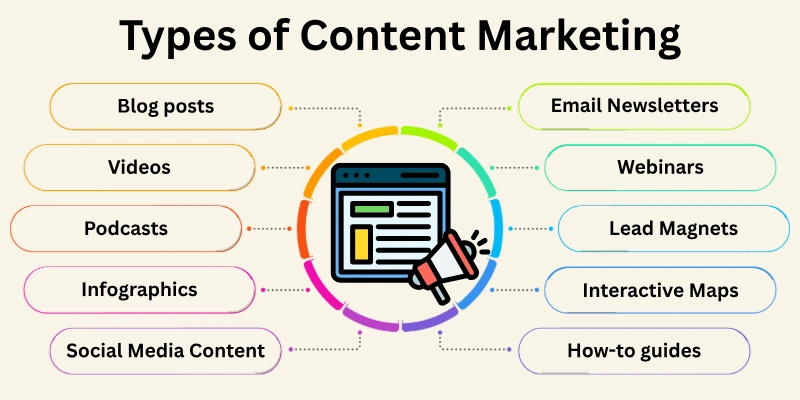
Here’s a complete list of content marketing types.
- Blog posts/Articles
- Videos
- Podcasts
- Infographics
- Social Media Content
- Email Newsletters
- Ebooks & White Papers
- Webinars
- Interactive Tools (Quizzes, Calculators)
- Courses or Online Training
- Lead Magnets
- Case Studies
- Paid Ads
- User-Generated Content
- Checklists & Templates
- How-to guides/Tutorials
- Interactive Maps
- Memes & GIFs
- Behind-the-Scenes Content
- Check-in Emails / Updates
- Challenges / Contests
- Slide Decks / Presentations
- Audio Snippets / Voice Notes
- Augmented Reality (AR) Experiences
- Virtual Events / Meetups
Let’s explore each one in detail.
1. Blog Posts/Articles
A blog post is a written article shared online to teach, inform, or entertain readers. It usually focuses on a specific topic or question. Blogs help brands share knowledge, solve problems, and attract people to their website.
They can include images, lists, or tips to make the content more helpful. Blogs are accessible anytime, making it easy for readers to read at their convenience.
Pros:
- Easy to write and publish
- Improves website traffic
- Helps build authority in your niche
Cons:
- Needs regular updates to stay relevant
- Can take time to get high readership
Example: A blog titled “10 Easy Tips to Boost Productivity at Home” that gives practical advice to readers.
2. Videos
Videos are visual content shared online to explain, demonstrate, or entertain audiences. They combine moving images, text, and sound to communicate ideas clearly. Videos can be short clips or long tutorials depending on the purpose.
They are effective for showing step-by-step instructions and making complex topics easier to understand. Videos are often posted on platforms like YouTube, Instagram, or websites for easy access.
Pros:
- Highly engaging and shareable
- Explains complex ideas quickly
- Can reach large audiences through social media
Cons:
- Takes time and resources to create
- Requires editing and planning for quality
Example: A tutorial video showing “How to Set Up a Home Office Efficiently” that walks viewers step by step.
3. Podcasts
Podcasts are audio programs shared online for listeners to consume on demand. They cover topics such as interviews, discussions, stories, or news. Podcasts allow audiences to learn while multitasking, like commuting or exercising.
They help brands connect with audiences through consistent episodes. Podcasts are usually available on streaming platforms and can be downloaded for convenience.
Pros:
- Builds a loyal audience
- Easy for people to consume on-the-go
- Cost-effective compared to video production
Cons:
- Requires consistent scheduling and planning
- Limited visual engagement
Example: A podcast series called “Marketing Tips for Small Businesses” that shares weekly advice in short episodes.
4. Infographics
Infographics are visual content that combines images, icons, and text to explain information clearly. They are used to display statistics, processes, or comparisons. Infographics make complicated data easier to understand quickly.
They can be shared on websites, social media, or presentations. Infographics are highly visual and attract attention while educating audiences.
Pros:
- Easy to understand at a glance
- Highly shareable on social media
- Simplifies complex data
Cons:
- Can take time to design
- Needs clear and accurate information
Example: An infographic showing “5 Steps to Improve Your Website SEO” with colorful icons and numbers.
5. Social Media Content
Social media content includes posts, images, videos, or stories shared on platforms like Facebook, Instagram, Twitter, or LinkedIn. It helps brands engage with audiences, promote products, or share information.
Social media content can be fun, informative, or promotional depending on the goal. It encourages interaction through likes, comments, and shares. Consistent posting builds brand awareness and visibility online.
Pros:
- Increases brand awareness
- Encourages direct engagement with followers
- Can go viral easily
Cons:
- Requires regular posting and monitoring
- High competition for attention
Example: A social media post showing “3 Quick Productivity Hacks” with a catchy graphic for Instagram.
6. Email Newsletters
Email newsletters are messages sent directly to subscribers’ inboxes to inform, educate, or promote. They provide updates about new content, products, or services.
Newsletters maintain ongoing communication with an audience. They can include tips, articles, offers, or announcements. Email newsletters are a personal way to reach readers consistently.
Pros:
- Direct communication with your audience
- Can be personalized for better engagement
- Encourages repeat visits and sales
Cons:
- Requires building a quality subscriber list
- Needs consistent sending to stay effective
Example: A weekly newsletter titled “Productivity Tips for Home Workers” that shares articles and short guides.
7. Ebooks & White Papers
Ebooks and white papers are long-form content that provides detailed information on a specific topic. They are often downloadable and used to educate or generate leads. Ebooks and white papers help brands show expertise and provide value beyond short articles.
They may include examples, case studies, statistics, and actionable tips. These formats are effective for in-depth learning and professional audiences.
Pros:
- Builds authority in your niche
- Can generate leads when offered as downloads
- Provides detailed, valuable content
Cons:
- Takes significant time and research to create
- Requires professional design for better presentation
Example: An ebook titled “The Ultimate Guide to Social Media Marketing for Beginners” that includes tips, templates, and examples.
8. Webinars
Webinars are live or recorded online sessions where brands teach, present, or interact with an audience. They often include slides, demonstrations, and Q&A sessions. Webinars allow brands to engage directly with participants in real time.
They can educate, demonstrate products, or provide actionable insights. Webinars are effective for building trust and authority with a target audience.
Pros:
- Provides live interaction with the audience
- Builds trust and authority
- Can capture leads through registration
Cons:
- Requires preparation and technical setup
- Attendance can be lower if not promoted well
Example: A live webinar titled “5 Strategies to Boost Your Instagram Engagement” where the host explains tactics and answers questions.
9. Interactive Tools (Quizzes, Calculators)
Interactive tools are online content pieces that allow users to engage directly by entering information or making choices. Quizzes, calculators, and polls are common examples. They help brands provide personalized results, insights, or recommendations.
Interactive tools keep audiences engaged because they participate rather than just read or watch. These tools are often embedded on websites, shared on social media, or used in marketing campaigns.
Pros:
- Highly engaging for users
- Provides personalized results
- Encourages sharing and interaction
Cons:
- Can be time-consuming to develop
- Requires accurate data to be effective
Example: A quiz titled “Which Productivity Style Fits You Best?” that gives personalized tips based on answers.
10. Courses or Online Training
Online courses or training programs are structured educational content delivered via websites or learning platforms. They teach skills or knowledge step-by-step and often include videos, quizzes, and assignments.
These courses help brands demonstrate expertise and provide high-value learning experiences. They are suitable for both free and paid formats. Courses can be self-paced or live, allowing flexibility for learners.
Pros:
- Builds authority and credibility
- Provides in-depth learning
- Can generate revenue if paid
Cons:
- Requires significant preparation and planning
- Needs ongoing updates to stay relevant
Example: An online course titled “Social Media Marketing for Beginners” that teaches learners strategies, tools, and tips.
11. Lead Magnets
Lead magnets are free resources offered to attract and capture potential customers’ contact information. Common types include guides, checklists, templates, or e-books. They are designed to provide value in exchange for an email or signup.
They help brands build a targeted email list and nurture potential leads. They are often used in marketing campaigns to convert visitors into subscribers.
Pros:
- Helps grow email lists quickly
- Provides immediate value to audiences
- Can lead to higher conversion rates
Cons:
- Must be high-quality to attract users
- Requires ongoing promotion to reach new audiences
Example: A free checklist titled “10 Steps to Organize Your Home Office” offered in exchange for an email signup.
12. Case Studies
Case studies are detailed accounts of how a product, service, or solution helped a client or customer achieve results. They usually highlight a problem, the solution implemented, and measurable outcomes.
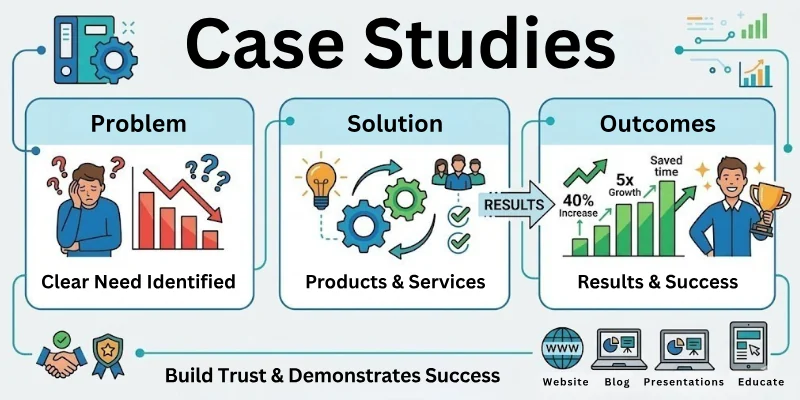
Case studies build credibility and demonstrate real-world success. They are often shared on websites, blogs, or presentations to educate and inspire potential customers.
Pros:
- Builds trust and authority
- Shows real-world results
- Helps convince potential customers
Cons:
- Takes time to collect accurate data
- Needs permission from clients/customers
Example: A case study showing how a small business increased sales by 50% using social media marketing.
13. Paid Ads
Paid ads are promotional content that brands pay to display on platforms like Google, Facebook, Instagram, or YouTube. They help reach specific audiences based on demographics, interests, or behaviour. Paid ads are designed to drive traffic, leads, or sales quickly.
They can be text, image, video, or carousel formats depending on the platform. Paid ads are measurable, allowing brands to track performance and optimize campaigns.
Pros:
- Immediate visibility for brands
- Can target specific audiences precisely
- Measurable results for ROI analysis
Cons:
- Can be expensive if not managed well
- Requires ongoing optimization for best results
Example: A Facebook ad promoting a free ebook download to people interested in productivity.
14. User-generated Content
User-generated content (UGC) is content created by your audience or customers rather than the brand itself. This can include reviews, photos, videos, or testimonials. UGC builds authenticity and trust because it comes from real users.
Brands often share UGC on social media, websites, or campaigns to engage others. It encourages community involvement and increases credibility.
Pros:
- Builds trust and authenticity
- Encourages audience engagement
- Low-cost content creation
Cons:
- Quality may vary and require curation
- Hard to control messaging completely
Example: A brand sharing a customer’s Instagram photo using their product with a testimonial caption.
15. Checklists & Templates
Checklists and templates are pre-made tools that guide users to complete tasks efficiently. They provide step-by-step guidance or ready-to-use formats.
These resources help audiences save time and reduce errors. Brands use them as valuable resources to educate or attract potential leads. They can be downloadable or used directly online.
Pros:
- Provides practical, actionable value
- Easy to use for audiences
- Encourages sharing and repeat visits
Cons:
- Requires careful design to be useful
- May need updates to stay relevant
Example: A template for “Weekly Social Media Content Planning” that readers can fill in and use immediately.
16. How-to Guides / Tutorials
How-to guides or tutorials are step-by-step instructions designed to teach readers how to do something. They focus on solving a specific problem or completing a task. These guides can be written, visual, or video-based.
They help audiences learn new skills and follow processes easily. How-to guides often break complex tasks into simple, actionable steps for better understanding.
Pros:
- Provides clear, actionable guidance
- Builds trust and authority
- Encourages audience engagement
Cons:
- Can take time to create detailed content
- Requires accuracy and clarity
Example: A tutorial titled “How to Set Up an Online Store in 30 Minutes” showing step-by-step instructions.
17. Interactive Maps
Interactive maps are online maps that users can click, zoom, or explore to get information. They allow audiences to engage with geographical or spatial data. These maps are used for tracking, directions, or showcasing locations of events or stores.
These maps make data more visually appealing and easy to understand. They are often embedded on websites or shared in campaigns.
Pros:
- Engages users with interactive features
- Makes location data easy to understand
- Can highlight multiple points of interest
Cons:
- Requires design and technical setup
- Can be complex for beginners to create
Example: A map showing “Top 10 Tourist Spots in New York” with clickable details for each location.
18. Memes & GIFs
Memes and GIFs are short, visual content pieces used for humour or quick messages. They are often shared on social media to entertain or make a point. Memes and GIFs grab attention because they are visually appealing and easy to consume.
Brands use them to connect with audiences in a fun, relatable way. They help increase engagement and shares.
Pros:
- Highly shareable and engaging
- Adds a fun, relatable touch to content
- Can reach younger audiences effectively
Cons:
- Can be easily misunderstood
- May not suit all brand tones
Example: A GIF showing a funny work-from-home scenario posted on a company’s Instagram.
19. Behind-the-Scenes Content
Behind-the-scenes content shows how a company, product, or team operates. It gives audiences a glimpse into the people, processes, or culture behind a brand. This type of content builds authenticity and humanizes the brand.
These posts can include photos, videos, or stories. They help audiences feel connected and involved.
Pros:
- Builds trust and transparency
- Humanizes the brand
- Encourages audience connection
Cons:
- Needs careful planning to be interesting
- May reveal sensitive information if not controlled
Example: A video showing the team creating a new product in the office.
20. Check-in Emails / Updates
Check-in emails or updates are messages sent to subscribers or customers to provide recent news, progress, or reminders. They help maintain regular contact with the audience.
These emails can include product updates, service reminders, or seasonal messages. Check-in emails are short, informative, and often personalized. They help keep the brand top-of-mind for recipients.
Pros:
- Maintains ongoing engagement
- Keeps audience informed
- Encourages repeat visits or interactions
Cons:
- Needs careful timing to avoid being annoying
- Requires concise and relevant content
Example: A monthly email update highlighting “New Features in Our Productivity App”.
21. Challenges / Contests
Challenges and contests are interactive campaigns that encourage audience participation. Users are invited to complete a task, submit entries, or compete for prizes. These campaigns increase engagement and visibility for the brand.
Challenges can be fun, educational, or promotional. They often create a sense of community and excitement around the brand.
Pros:
- Boosts audience engagement
- Increases social sharing and visibility
- Encourages community participation
Cons:
- Requires planning and clear rules
- Can be resource-intensive to manage
Example: A social media photo contest titled “Show Us Your Home Workspace” with a prize for the best submission.
22. Slide Decks / Presentations
Slide decks or presentations are visual content created to explain concepts, share information, or teach audiences. They often combine text, images, and charts to make ideas clear.
Presentations can be used live, shared online, or embedded on websites. They are useful for education, training, or marketing purposes. Slide decks provide structured and easy-to-follow content.
Pros:
- Organizes information clearly
- Can be shared or repurposed easily
- Supports visual learning
Cons:
- Takes time to design effectively
- May require graphic tools for quality
Example: A presentation titled “5 Key Steps to Improve Website SEO” shared on LinkedIn SlideShare.
23. Audio Snippets / Voice Notes
Audio snippets or voice notes are short audio clips shared to convey information or messages. They can be recorded on mobile devices or in studios. These snippets are often used for tips, updates, or announcements.
Audio content is easy for audiences to consume while multitasking. They can be shared via social media, apps, or messaging platforms.
Pros:
- Easy for audiences to consume on-the-go
- Adds a personal touch to communication
- Quick to create and share
Cons:
- Limited visual engagement
- May require clear audio quality
Example: A 2-minute voice note giving “Quick Productivity Tips for the Day” shared on WhatsApp or Instagram.
24. Augmented Reality (AR) Experiences
AR experiences overlay digital content onto the real world through apps or devices. Users can interact with virtual elements in their environment. Brands use AR for virtual try-ons, interactive ads, or immersive experiences.
AR content is engaging and highly interactive. It provides a memorable way for audiences to experience products or services.
Pros:
- Highly interactive and immersive
- Creates a memorable user experience
- Encourages sharing and engagement
Cons:
- Requires technology and development skills
- Can be expensive to implement
Example: A furniture brand using AR to let users visualize how a chair looks in their room.
25. Virtual Events / Meetups
Virtual events or meetups are online gatherings where brands connect with audiences, customers, or communities. They can include webinars, live streams, workshops, or networking sessions.
Virtual events allow interaction without physical attendance. They help build engagement, relationships, and brand awareness. These events can be live or recorded for later access.
Pros:
- Connects with audiences globally
- Encourages real-time interaction
- Builds community and brand presence
Cons:
- Requires planning and technical setup
- Attendance depends on promotion and timing
Example: A live virtual meetup titled “Marketing Strategies for Small Businesses” with Q&A sessions and networking opportunities.
How Content Marketing Helps Your Business Grow
After exploring the different kinds of content marketing, I realized how powerful they can be in growing a business. Each type of content serves a unique purpose, and when used strategically, they can bring incredible results.
Here are some ways content marketing can help your business grow:
- Increase Visibility: Consistently sharing valuable content helps your brand appear in search results and on social media, making more people aware of your business.
- Build Authority: Creating informative blogs, e-books, and webinars positions your brand as an expert in your industry, earning trust from your audience.
- Engage Audience: Content like videos, quizzes, and social media posts keeps your audience interested and encourages them to interact with your brand.
- Generate Leads: Lead magnets, email newsletters, and downloadable guides help capture potential customer information for future marketing efforts.
- Boost Conversions: Clear tutorials, case studies, and how-to guides help guide potential customers toward making a purchase or using your services.
- Improve SEO: Regular content like blogs, infographics, and videos helps your website rank higher in search engines, attracting more organic traffic.
- Enhance Brand Loyalty: Behind-the-scenes content, newsletters, and interactive experiences keep your existing audience engaged and loyal over time.
- Cost-Effective Marketing: Compared to paid ads, content marketing often provides long-term results without ongoing high expenses, making it a smart investment.
FAQs: Types of Content Marketing
Here’s a list of questions people often have about types of content marketing in digital marketing.
Content marketing includes different content formats that help brands share useful information with people. The main types include blog posts, videos, social media content, email newsletters, podcasts, infographics, ebooks, and more. These types help you reach your audience in different ways and provide value that keeps people interested and engaged.
To choose the right type of content marketing, first think about your goals and audience. If your audience likes reading, blogs may work well. If they prefer watching, video content might be better. Try a few types and check what gets more views, clicks, and engagement.
Yes! Different types of content marketing like blog posts and videos help your website show up in search engines. When you use the right keywords and share helpful content, more people can find your site and visit it. This brings more traffic over time.
For social media, short and engaging content works best. This can include images, short videos, memes, and behind‑the‑scenes posts. These types help you connect with followers and encourage likes, shares, and comments.
Yes, using more than one type of content marketing helps you reach more people. Some users like reading, others like watching, and some like listening. Combining types like blog posts, videos, and email newsletters can make your strategy stronger and more effective.
You should make new content based on a schedule that you can keep up with. Whether it’s once a week or every few days, consistency is key. Regular updates help keep your audience interested and grow your online presence.
Yes, using different content marketing types boosts engagement because each type connects with people in a unique way. For example, videos and interactive quizzes encourage users to watch and interact, while emails and how‑to guides keep them informed and involved.
Absolutely! Small businesses can use content marketing types like blogs, social posts, and email newsletters to attract customers without spending much money. Good content builds trust and makes people more likely to support your business.
Wrapping Up
Throughout this article, we have explored the different types of content marketing and how each can benefit your business.
From blog posts and videos to email newsletters and interactive tools, every type has a unique way of engaging your audience and building trust. Using a combination of these content types consistently can boost visibility, drive traffic, and strengthen your brand.
Take action today and start creating the right content to grow your business and connect with your audience!


- Be Respectful
- Stay Relevant
- Stay Positive
- True Feedback
- Encourage Discussion
- Avoid Spamming
- No Fake News
- Don't Copy-Paste
- No Personal Attacks
- Be Respectful
- Stay Relevant
- Stay Positive
- True Feedback
- Encourage Discussion
- Avoid Spamming
- No Fake News
- Don't Copy-Paste
- No Personal Attacks
