Advantages and Disadvantages of Content Marketing
Published: 14 Jan 2026
Have you ever wondered how businesses reach their customers in today’s digital world? Well, it’s all thanks to content marketing.
Content marketing is the strategy of creating and sharing valuable content to attract, engage, and retain an audience. It’s one of the most powerful tools for driving business growth.
But, just like everything else, content marketing has its ups and downs. So, let’s dive into the advantages and disadvantages of content marketing and see what this strategy truly offers.
Advantages of Content Marketing
Content marketing has numerous advantages, and today we’ll cover just a few of them. Let’s see where and how it can benefit your business and contribute to its growth.
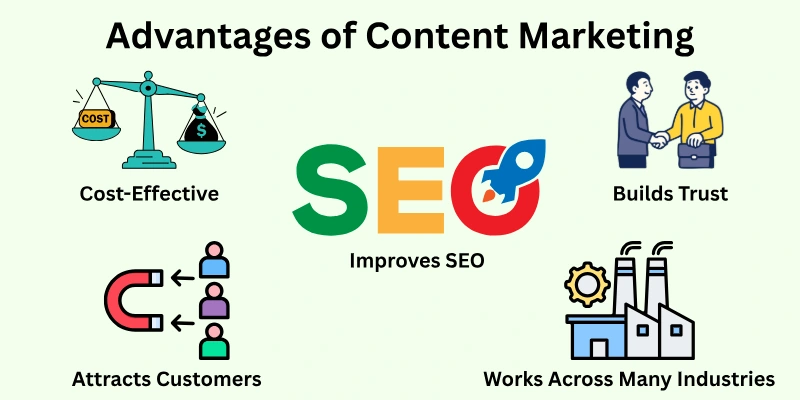
Here is the list of benefits of content marketing:
- Cost-Effective
- Builds Trust and Authority
- Improves SEO and Drives Traffic
- Attracts Customers
- Works Across Many Industries
Let’s discuss each of these in greater detail.
1. Cost-Effective
Content marketing is cheaper than traditional ads like TV commercials or billboards. You can create and share useful content without spending a lot of money. This is great for small businesses that don’t have big marketing budgets.
Once you create good content, it keeps working for you. It can continue to bring people to your website and build your brand over time. Ads, on the other hand, stop working once you stop paying for them.
- Lower production costs than traditional ads.
- Free or low-cost sharing on social media and websites.
- Always-useful content gives long-lasting results.
- No need for costly media buys or ad spots.
- Flexible for different budgets.
2. Builds Trust and Authority
By offering helpful content, you build trust with your audience. When people find your content useful, they start to see your brand as an expert. This helps create a relationship with them. Trust is important for turning visitors into customers.
Content marketing also helps you become an authority in your field. When you share useful content regularly, people will see you as a reliable source for information.
- Helps build credibility with your audience.
- Makes your brand a trusted resource.
- Establishes your business as an expert.
- Encourages repeat visits from your audience.
- Builds customer loyalty.
3. Improves SEO and Drives Traffic
Content marketing helps your website rank higher on search engines like Google. The more good content you create, the more likely your website is to show up in search results when people are looking for solutions.
Content also helps increase traffic to your website. As you add more content, more people can find your site through search engines.
- Helps your website rank higher in search engines.
- Increases organic traffic to your website.
- Content acts as a magnet for search engines.
- Provides more chances for backlinks.
- Continues to bring traffic for months or years.
4. Attracts Customers
Creating helpful content helps businesses attract new customers. By sharing tips or solving common problems, companies make people want to visit their website. This builds trust, and when customers trust a brand, they are more likely to make a purchase.
Offering valuable content consistently helps businesses stand out. Instead of just focusing on sales, they provide real solutions, which keep customers coming back.
- Shares useful information that solves problems.
- Builds trust, making customers more likely to buy.
- Increases website visits through valuable content.
- Stands out from competitors by providing real solutions.
- Helps build a loyal customer base over time.
5. Works Across Many Industries
Content marketing works for all businesses, whether selling products, services, or information. It helps reach your target audience, like product guides for e-commerce or health tips for healthcare. It’s customizable for any industry, making it a flexible tool.
No matter the industry, content marketing boosts brand awareness, trust, and customer connection.
- Works for both product-based and service-based businesses.
- Helps reach different target audiences in various industries.
- Provides tailored content based on the business’s focus.
- Builds brand awareness and trust across any field.
- Effective for industries like e-commerce, healthcare, education, and more.
Disadvantages of Content Marketing
Content marketing offers great benefits, but it also comes with its share of challenges. Let’s take a closer look at the cons and how they might affect your business.
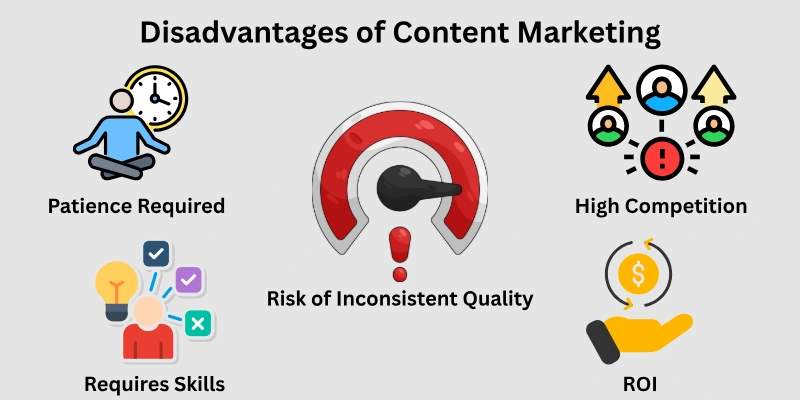
Below are the main cons of content marketing:
- Time and Patience Required
- Requires Skills and Resources
- Hard Measurement and ROI
- High Competition and Algorithm Risks
- Risk of Inconsistent Quality or Frequency
Let’s break them down further.
1. Time and Patience Required
Content marketing takes time to show results. Unlike paid ads, where you can quickly see results, content marketing needs patience. It may take months before you see a lot of traffic or results.
Also, content marketing needs regular effort. You have to keep creating content to see long-term success. If you want to do it right, it’s a long-term commitment.
- Slow results compared to other marketing methods.
- Requires ongoing effort to keep content fresh.
- It can take months before you see significant returns.
- Long-term commitment is needed for success.
- Requires patience and consistency.
2. Requires Skills and Resources
Content marketing isn’t easy. It needs different skills to create great content. You need to be able to write well, design visuals, and plan your content carefully. If you don’t have these skills, you might need to hire people to help.
Creating quality content also takes time. You need a team or resources to keep up with content creation regularly.
- Requires writing, editing, and design skills.
- Needs time and resources for content creation.
- May need a team or external help.
- It can be challenging without the right expertise.
- Demands consistent production and quality.
3. Hard Measurement and ROI
It can be tough to measure how well your content is doing. Unlike paid ads, where you can easily see how much money you’ve spent and how many sales you’ve made, content marketing doesn’t always give clear, direct results.
Tracking website visits, engagement, and leads is possible, but it’s still hard to measure the exact impact of content. It’s often an indirect way to increase sales.
- Harder to measure ROI than with paid ads.
- Requires multiple tools to track success.
- It’s an indirect path to conversions and sales.
- Difficult to directly link content to sales.
- Needs careful monitoring of metrics over time.
4. High Competition and Algorithm Risks
Many businesses use content marketing, so it can be hard to stand out. There’s a lot of content out there, and you need to create something better than everyone else to get noticed.
Also, search engines and social media platforms regularly change their algorithms. These changes can affect how your content is seen, which makes it harder to rely only on content marketing.
- High competition for attention and search engine rankings.
- Changes in algorithms can impact visibility.
- Hard to stand out in crowded markets.
- Requires constant adaptation to platform changes.
- May need to invest in paid promotion to boost visibility.
5. Risk of Inconsistent Quality or Frequency
It’s important to keep your content consistent. If your content quality drops or if you don’t post regularly, your audience might lose interest. Consistency is key to keeping people engaged.
Without a plan, it’s easy to fall behind. This can lead to inconsistent posting, which can hurt your brand’s reputation.
- Inconsistent quality or posting can lead to loss of audience.
- Requires a well-planned content schedule.
- It can hurt your brand if the content drops in quality.
- Needs continuous attention to maintain engagement.
- Missed posts can reduce customer trust.
Tips for Successful Content Marketing
To make your content marketing effective, follow these simple tips:
- Content: Write content that is easy to read and helps your audience. Avoid long or confusing sentences.
- Post: Share new content often. Consistency helps people trust your brand.
- SEO keywords: Add important words that people search for. This helps your content appear on Google.
- Promote: Share your blogs, videos, or posts on platforms like Facebook, Instagram, or LinkedIn.
- Track: Check which content works best. Improve your future content based on what people like.
- Audience: Understand what your audience needs and create content that solves their problems.
FAQs
Here are some typical questions about the pros and cons of content marketing:
One advantage of content marketing is that publishing informative and well-researched content helps your business appear trustworthy and authoritative. When people trust you for good information, they are more likely to buy from you. This helps build a strong brand for your business.
Advantages: Content marketing helps you connect with your audience and build relationships. This can lead to more sales over time.
Disadvantages: Some challenges of content marketing include coming up with good content ideas and finding enough time to write and publish them.
The 4 Ps of content marketing are:
- Product – Offering the right product or service.
- Price – Setting the right price for your product.
- Place – Ensuring your product is available in the right place.
- Promotion – Promoting your product in the right way.
These four elements help ensure your marketing is effective by focusing on the right product, price, place, and promotion.
The five main content marketing goals are:
- Brand Awareness – Making your brand known.
- Brand Loyalty – Keeping customers loyal.
- Customer Education – Teaching customers about your products.
- Customer Engagement – Getting customers to interact with your brand.
Talent Recruitment – Attracting new employees.
The four E’s of content marketing are:
- Educates – Content that teaches something new.
- Engages – Content that encourages interaction.
- Entertains – Content that is fun and enjoyable.
- Empowers – Content that gives people the tools or confidence to take action.
Yes, content marketing is in high demand. According to new research from Adobe, 96% of marketers have seen content demand double in the last two years, with 62% reporting that it has increased five times or more.
Conclusion
In this article, we’ve explored both the advantages and disadvantages of content marketing. While content marketing offers significant benefits, such as increased brand awareness and customer engagement, it’s important to keep in mind the challenges it brings, like the time and resources needed for success.
Use content marketing to grow your business, but remember to stay aware of the effort and consistency required to make it truly effective.
I hope this information helps you understand content marketing better. Feel free to share your thoughts or ask questions in the comments!






- Be Respectful
- Stay Relevant
- Stay Positive
- True Feedback
- Encourage Discussion
- Avoid Spamming
- No Fake News
- Don't Copy-Paste
- No Personal Attacks
- Be Respectful
- Stay Relevant
- Stay Positive
- True Feedback
- Encourage Discussion
- Avoid Spamming
- No Fake News
- Don't Copy-Paste
- No Personal Attacks
