Types of Anchor Text: Easy Guide for Better Rankings
Published: 31 Aug 2026
If you are new to SEO, you may feel confused when you hear about types of anchor text. It can look small, but it plays a big role in ranking a website.
Anchor text is the clickable part of a link, and it comes in different forms. Each type helps search engines understand your content in a different way.
Some types are strong for SEO, while others are used for natural linking.
In this article, we will cover all types of anchor text, their simple meaning, real examples, and easy tips so you can use them correctly in your own content.
Anchor Text Types
There are many types of anchor text used in SEO. Each type plays a different role in how search engines understand your links and how users interact with your content. When you use the right mix, your website looks more natural and performs better in search results.
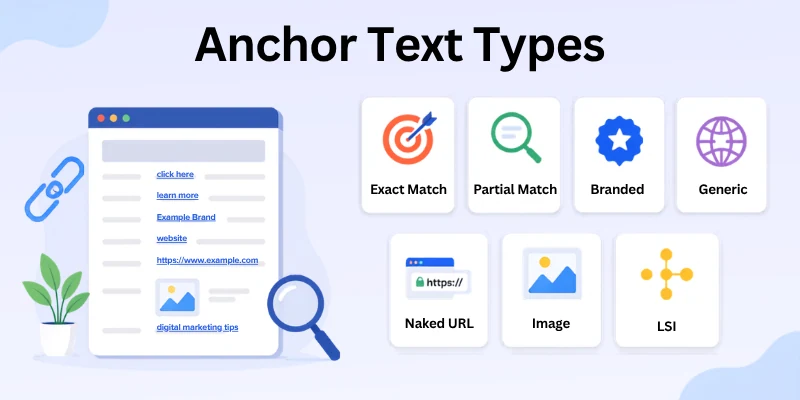
Types of Anchor Text:
- Exact Match Anchor Text
- Partial Match Anchor Text
- Branded Anchor Text
- Generic Anchor Text
- Naked URL Anchor Text
- Image Anchor Text
- LSI (Related Keywords) Anchor Text
Let’s cover them in detail.
1. Exact Match Anchor Text
Exact match anchor text uses the same words as the target keyword inside the link. For example, if the keyword is “best SEO tools,” the anchor text will also be exactly “best SEO tools.” It gives a very clear signal to search engines about the topic of the page.
Search engines read this as a strong relevance signal. It helps them understand what the linked page is about. But if you use it too much, it can look unnatural and forced.
- Use only when the link is highly relevant
- Place it inside natural flowing sentences
- Keep usage low to avoid over-optimization
- Best for internal linking between related pages
2. Partial Match Anchor Text
Partial match anchor text includes the main keyword, but it also adds extra words around it. Instead of using the exact phrase, you slightly change it. For example, “best tools for SEO work” instead of only “SEO tools.”
It helps your content sound more natural. Readers feel it fits better inside sentences. Search engines also see it as a safer linking style compared to an exact match.
- Add helpful words before or after the keyword
- Use it to support related topics in content
- Keeps linking natural and reader-friendly
- Works well in blog articles and guides
3. Branded Anchor Text
Branded anchor text uses the name of a brand as the clickable link. For example, “Nike” or “OpenAI tools” can be used as anchor text. It does not focus on keywords, only on the brand identity.
People trust branded links more because they look natural and real. It also helps build authority for your website or business over time.
- Use your brand name in guest posts and mentions
- Helps build strong brand recognition
- Safe for SEO and widely accepted by Google
- Useful for long-term authority building
4. Generic Anchor Text
Generic anchor text uses simple phrases like “click here,” “read more,” or “learn more.” It does not include keywords or brand names.
Readers easily understand these links because they act like simple buttons. However, they do not give strong SEO signals about the linked page.
- Use in call-to-action buttons
- Keep it simple and user-focused
- Works well for navigation links
- Do not depend on it for SEO ranking value
5. Naked URL Anchor Text
Naked URL anchor text shows the full website link as it is. For example, https://example.com appears directly in the content without any change.
It is mostly used when you want to show a source or reference. It looks transparent, but it does not help much with keyword SEO.
- Use in references or citations
- Good for trust and transparency
- Avoid using in main content sections
- Best for technical or formal writing
6. Image Anchor Text
When an image becomes a clickable link, it works as image anchor text. Search engines read the alt text of the image to understand the link context.
It improves both SEO and accessibility. Users who cannot see images still understand what the link is about through alt text.
- Write clear and simple alt text
- Link images only to useful pages
- Keep alt text relevant to the content topic
- Avoid empty or irrelevant descriptions
7. LSI (Related Keywords) Anchor Text
LSI anchor text uses words related to your main keyword instead of repeating the exact phrase. It helps add meaning without sounding repetitive.
Search engines use it to understand topic depth. It also makes your content feel more natural and readable.
- Use synonyms and related phrases
- Keep meaning close to the main topic
- Helps avoid keyword stuffing issues
- Improves overall SEO context strength
How Search Engines Use Anchor Text
Search engines use anchor text to understand what a linked page is about. When a page links to another page, the clickable text gives a strong meaning signal. This helps Google decide how relevant that page is for a topic.
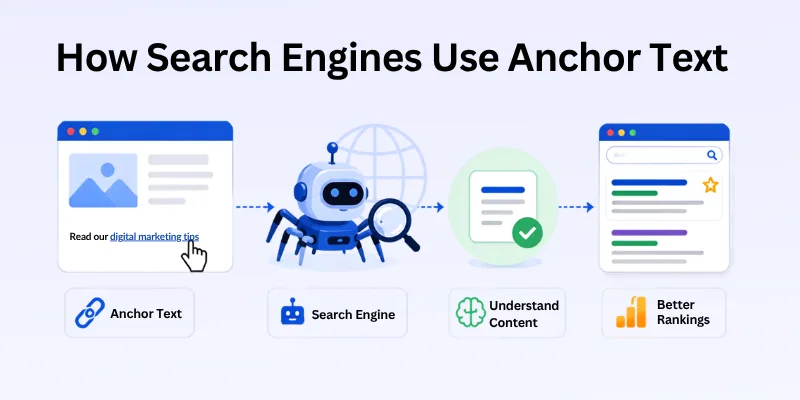
Anchor text also helps search engines connect different pages across the web. It acts like a small clue that tells what users will find after clicking a link.
- Search engines read anchor text to understand the page topic
- It helps Google connect related content across websites
- Strong and relevant anchor text improves page relevance signals
- It supports better ranking for targeted keywords
- It helps search engines build context between linked pages
- Natural anchor text improves trust and reduces spam signals
Common Anchor Text Mistakes
Many people use anchor text without a clear plan. This can hurt SEO and also confuse readers. Good anchor text should feel natural and match the content flow.
When mistakes happen, search engines may see your links as spammy or low quality. That is why balance and natural use always matter more than keyword stuffing.
- Using the same anchor text again and again
- Overusing exact match keywords in every link
- Adding links that do not match the topic relevance
- Using too many generic words like “click here”
- Placing links in forced or unnatural sentences
- Ignoring user experience while adding links
- Linking to pages that do not add real value or context
Conclusion
In this article, we’ve covered types of anchor text in detail. From my experience, the best results come when you focus on user-friendly linking instead of forcing keywords.
A natural mix of anchor text types always performs better in the long run. It keeps your content clean, readable, and SEO-safe.
If you apply these simple practices, you will see steady improvement in your rankings.
I hope this guide gave you real value. If it helped you, feel free to explore more SEO content and take your learning to the next level.
FAQs: Types of Anchor Texts
Before we finish, let’s clear some common doubts that many readers have about types of anchor text. These questions will help you understand the topic better and use it in a more practical way.
Anchor text should be added naturally inside your content. It should guide readers to useful related pages. Always match the link with the topic for better SEO results.
- Add links only where they make sense
- Use simple and natural wording
- Avoid forcing keywords into sentences
- Link to helpful and relevant pages
Exact match anchor text uses the same keyword as the target page. For example, using “types of anchor text” as the clickable link. It should be used carefully to avoid over-optimization issues.
There are several types of anchor text used in SEO. The main ones include exact match, partial match, branded, generic, naked URL, image, and LSI anchor text. These cover most linking strategies used in websites.
There is no single best type because balance is important. A mix of branded, partial match, and natural anchor text works best. Overusing one type can look spammy and reduce SEO value.
Yes, overusing anchor text can harm your SEO performance. Search engines may see it as unnatural linking or spam. It is better to keep a natural mix and focus on user experience.
- Use different anchor text variations
- Avoid repeating the same keyword links
- Keep links relevant to the topic
- Focus on natural sentence flow
Internal anchor text links pages within your own website. External anchor text links to other websites. Both help search engines understand content structure and trust signals.



- Be Respectful
- Stay Relevant
- Stay Positive
- True Feedback
- Encourage Discussion
- Avoid Spamming
- No Fake News
- Don't Copy-Paste
- No Personal Attacks
- Be Respectful
- Stay Relevant
- Stay Positive
- True Feedback
- Encourage Discussion
- Avoid Spamming
- No Fake News
- Don't Copy-Paste
- No Personal Attacks
