Advantages and Disadvantages of Marketing Automation
Published: 14 Jan 2026
Have you ever wondered why some brands grow fast while others struggle, even when they post every day? I asked myself the same question when I started learning about the advantages and disadvantages of marketing automation.
After using these tools in real projects, I learnt that success depends on smart work and a clear understanding of your customers.
Today, I want to share this experience with you and explain the pros and cons of marketing automation in a simple and honest way.
So let’s start understanding this topic clearly.
Advantages of Marketing Automation
Marketing automation can make marketing work much easier for any business. It helps teams manage their tasks better and get things done faster.
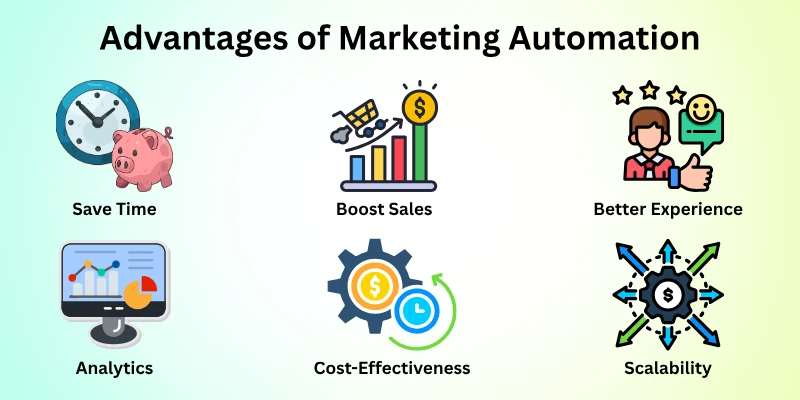
Here is the list of advantages of marketing automation:
- Save Time and Work Smarter
- Guide Leads and Boost Sales
- Better Experience for Customers
- Data Collection and Analytics
- Cost-Effectiveness
- Scalability
Let’s see in detail.
1. Save Time and Work Smarter
Marketing automation saves time by doing repetitive tasks for you. Instead of doing everything manually, you can schedule emails and social media posts and manage leads with just a few clicks. This gives your team more time to focus on creative ideas and important plans.
Automation helps campaigns run faster, reduces mistakes, and allows many tasks to happen at once. Overall, it makes marketing smarter and more productive.
Benefits of efficiency and time-saving:
- Schedule emails and posts automatically.
- Run multiple campaigns at the same time.
- Reduce errors from manual work.
- Free up time for creative planning.
- Increase productivity with fewer resources.
2. Guide Leads and Boost Sales
Lead nurturing means guiding potential customers until they are ready to buy. Automation makes this easier. You can send relevant emails, suggest offers, or follow up at the right time without tracking leads manually.
Tools like lead scoring help focus on prospects most likely to buy. This creates a smooth experience for customers and helps the sales team close more deals.
How automation improves lead nurturing:
- Send the right message to the right lead automatically.
- Suggest products or offers based on behaviour.
- Focus on leads ready to buy first.
- Collect useful data to improve campaigns.
- Engage leads instantly without delays.
3. Better Experience for Customers
Automation helps give customers a personal experience. Tools track actions and respond automatically to keep leads moving. For example, if someone opens a welcome email, they can be added to the next series that fits their interests.
This keeps your brand in their mind and makes the customer feel cared for. Automation also allows faster responses, better support, and builds trust.
Ways automation enhances customer experience:
- Personalize emails and messages for each user.
- Keep leads engaged with timely follow-ups.
- Respond faster to customer actions.
- Maintain consistent communication across channels.
- Make customers feel valued and understood.
4. Data Collection and Analytics
Automation helps you collect important information about your audience. It tracks clicks, email opens, purchases, and social interactions automatically.
This data shows what works and what doesn’t, helping you make better decisions. With real-time analytics, you can act quickly and improve future campaigns.
How automation helps with data:
- Track customer actions on emails, social media, and websites.
- Measure open rates, clicks, and conversions automatically.
- Find out which campaigns work best.
- Use data to target marketing better.
- Build detailed customer profiles for later campaigns.
5. Cost-Effectiveness
Automation tools need some investment, but they save money over time. Less manual work means fewer hours spent by your team. Automation also improves conversions, so businesses get more value from campaigns.
Overall, it helps companies grow without spending too much on manual work or ineffective strategies.
Why automation is cost-effective:
- Save on labour by automating repetitive tasks.
- Increase ROI with better conversions.
- Avoid spending on campaigns that fail.
- Reduce the costs of managing multiple channels.
- Focus on strategies that matter most.
6. Scalability
As a business grows, marketing becomes harder to manage manually. Automation allows you to handle more leads, campaigns, and customer data easily. You can grow marketing efforts while keeping messages personal and effective. This helps your business expand without losing quality.
How automation supports scalability:
- Manage large numbers of leads and campaigns easily.
- Keep messages personal for each customer.
- Maintain consistent marketing as your business grows.
- Handle complex workflows without extra effort.
- Expand campaigns without losing efficiency.
Disadvantages of Marketing Automation
Marketing automation is helpful, but it also has some problems. Many businesses feel happy when they start using these tools, but later they see that it is not always easy.
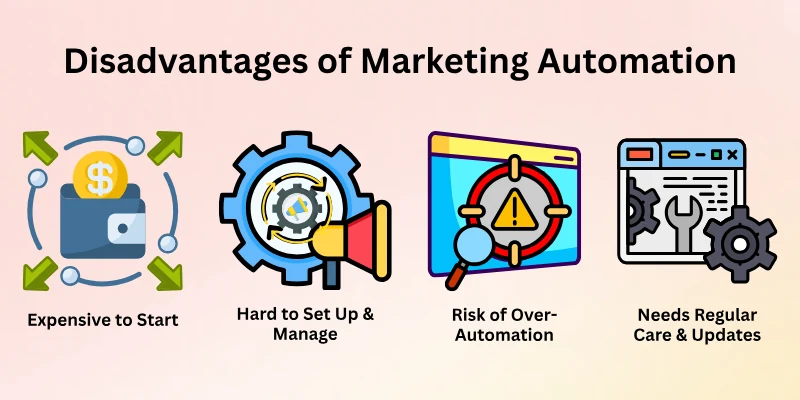
Before choosing any tool, it is important to understand these drawbacks so your marketing stays honest, human, and effective.
- Expensive to Start
- Hard to Set Up and Manage
- Risk of Over-Automation
- Needs Regular Care and Updates
Let’s look at them in detail.
1. Expensive to Start
Marketing automation can save money in the long run, but starting is expensive. You need to pay for the software and the monthly or yearly fees. Some companies also charge extra for setup, training, and special features. If you want to add custom options, the cost gets even higher.
For small businesses or new companies, these costs can feel too heavy. Even after setup, you still need money for updates and maintenance. Because of this, many small companies find it difficult to invest in automation at the start.
Why high costs can be a problem:
- Software fees can be expensive for beginners.
- Training and setup cost extra money.
- Updates and new features add more expenses.
- Small companies may not have enough budget.
- It feels risky if the tool is not used well.
2. Hard to Set Up and Manage
Setting up marketing automation is not simple. You need to build workflows, connect different tools, and manage data correctly. This takes time and technical skills. If your team does not understand automation, the process can feel confusing.
Even after setup, you must keep checking segments, updating data, and improving campaigns. Without trained people, the tool may not work well, and you may not get good results.
Why automation feels complicated:
- You need technical skills to build workflows.
- Connecting tools takes time and knowledge.
- Regular updates are needed to keep things working.
- Teams must understand customer data.
- Without trained staff, results will not be great.
3. Risk of Over-Automation
Automation becomes a problem when you use it too much. If every message is automated, customers may feel like they are talking to a robot. This makes your brand look cold and less personal. People want warm and human-like messages.
If messages repeat or do not match the customer’s need, people start ignoring them. So it’s important to balance automation with real human communication.
Why over-automation hurts your marketing:
- Messages sound robotic and not friendly.
- Customers may feel unimportant.
- Automated emails don’t fit every situation.
- Engagement drops when messages feel copied.
- The human touch disappears.
4. Needs Regular Care and Updates
Many people think automation works on its own. But it does not. You must watch it, test it, and update it often. You need to check campaign performance, update old workflows, and improve messages based on customer behaviour.
If you don’t update your system, your messages will become old or irrelevant. This leads to poor results and missed chances. Automation works best when you treat it as an active part of your marketing strategy.
Why automation needs constant attention:
- You must check and update it regularly.
- Campaigns must match new trends and needs.
- Old workflows stop working well over time.
- Poor maintenance reduces engagement.
- It works only when you keep improving it.
Conclusion
So guys, it’s time to sum up. In this article, we’ve covered advantages and disadvantages of marketing automation in detail. I personally recommend exploring automation for repetitive tasks while keeping a human touch for customer interactions.
Start with one or two processes and see how they improve your workflow. Ready to make your marketing easier?
Give automation a try and watch your productivity increase!
FAQs: Advantages and Disadvantages of Marketing Automation
If you still have questions about the pros and cons of marketing automation, these frequently asked questions can help you understand it better:
Marketing automation has many benefits, like saving time, improving efficiency, and helping businesses stay in touch with customers easily. It also allows sending personalized messages and nurturing leads automatically. On the other hand, it can be expensive to set up, a bit complicated to learn, and sometimes feel less personal if overused. Businesses should consider both the benefits and drawbacks before using it.
Here are the main benefits of using marketing automation for your business:
- Saves time and makes marketing tasks easier.
- Improves customer data and builds better profiles.
- Helps create personalized experiences for customers.
- Enhances customer satisfaction and engagement.
The 7 simple steps are
- Find your starting point.
- Do market research.
- Define your target audience.
- Set measurable goals.
- Get budget approval.
- Choose marketing strategies.
- Make a schedule and start.
The main goal of marketing automation is to make marketing faster and easier.
- Save time on repetitive tasks.
- Improve efficiency.
- Make campaigns more consistent.
Many marketers use automation to save time and improve results. Common uses include:
- 58% use it for email marketing.
- 49% use it for social media management.
- 51% use it for customer profiling.
- 77% use it to create personalized content for their audience.
These countries are leading in automation and robotics:
- South Korea: 1,000 robots per 10,000 workers (highest in manufacturing).
- Singapore: 670 robots per 10,000 employees (second place).
- Japan: Over 390 robots per 10,000 employees (third place).




- Be Respectful
- Stay Relevant
- Stay Positive
- True Feedback
- Encourage Discussion
- Avoid Spamming
- No Fake News
- Don't Copy-Paste
- No Personal Attacks
- Be Respectful
- Stay Relevant
- Stay Positive
- True Feedback
- Encourage Discussion
- Avoid Spamming
- No Fake News
- Don't Copy-Paste
- No Personal Attacks
