Key Advantages and Disadvantages of Mobile Marketing
Published: 14 Jan 2026
Mobile marketing is a method of promoting products or services using mobile devices, such as smartphones and tablets. Businesses send messages, display ads, or utilize apps to connect with people on their phones.
Mobile marketing is very important today because almost everyone uses a phone. People check their phones many times every day. Businesses can reach customers quickly and easily.
In this article, we will show the advantages and disadvantages of mobile marketing. You will learn how it helps businesses and what problems it can have.
So, without any delay, let’s jump straight into the pros and cons of mobile marketing.
Advantages of Mobile Marketing
Mobile marketing offers many ways for businesses to connect with customers using their phones. It helps reach people quickly, creatively, and effectively.
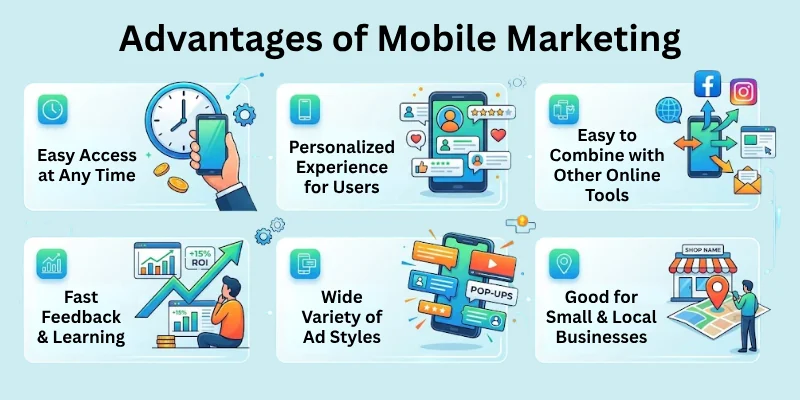
Here are the top mobile advertising benefits for all businesses.
- Easy Access at Any Time
- Personalized Experience for Users
- Easy to Combine with Other Online Tools
- Fast Feedback and Learning
- Wide Variety of Ad Styles
- Good for Small and Local Businesses
Let’s see the pros of mobile marketing.
1. Easy Access at Any Time
People carry their phones all day. Businesses can reach customers in the morning, afternoon, or evening. Mobile marketing works whenever customers check their phones.
This makes it very helpful for urgent offers, sales, or time-sensitive announcements. Businesses can reach people instantly and get fast responses.
- Reach customers anytime
- Ideal for urgent offers
- Works 24/7 without extra cost
- Connect with busy users easily
Tip: Use timing wisely for better response rates, like sending offers during active hours.
2. Personalized Experience for Users
Businesses can send messages or ads based on location, interests, or past actions. Customers see content that is relevant to them, not random ads.
Personalized messages make customers feel valued. It builds trust, strengthens relationships, and increases the chance of buying.
- Show ads based on user behaviour
- Build customer trust
- Increase the chance of sales
- Make users feel special
Insight: Personal messages usually get higher engagement and trust.
3. Easy to Combine with Other Online Tools
Mobile marketing works well with apps, social media, or email. Businesses can use several tools together to reach more people. Combining tools increases visibility. It allows businesses to reach customers in different ways, making marketing stronger.
- Work with apps, social media, and email
- Increase reach and visibility
- Use multiple channels at once
- Improve marketing results
Benefit: Multi-channel marketing improves brand visibility faster.
4. Fast Feedback and Learning
Businesses can track clicks, opens, or actions instantly. They can see which ads or messages work best. Fast feedback helps improve marketing quickly. Businesses can make better decisions and fix mistakes without delay.
- Track results instantly
- Learn what works fast
- Improve ads and messages quickly
- Make data-driven decisions
Fact: Quick feedback helps improve campaigns in less time.
5. Wide Variety of Ad Styles
Mobile marketing allows text messages, videos, banners, or social media posts. Businesses can create creative content that attracts attention.
Creative ads are more engaging than plain messages. They help businesses stand out in a crowded market.
- Use text, video, banners, or posts
- Create creative ads
- Catch customer attention easily
- Stand out from competitors
Example: Short videos often perform better than plain text ads.
6. Good for Small and Local Businesses
Small shops or local businesses can use mobile marketing even with low budgets. They can reach nearby customers effectively.
Mobile marketing helps small businesses compete with big companies. Even a small campaign can generate sales and increase brand awareness.
- Affordable for small businesses
- Reach local customers easily
- Compete with big brands
- Generate sales with a low budget
Tip: Local targeting helps increase store visits and sales.
Disadvantages of Mobile Marketing
Mobile marketing offers many benefits, but it also comes with challenges that businesses must handle carefully.
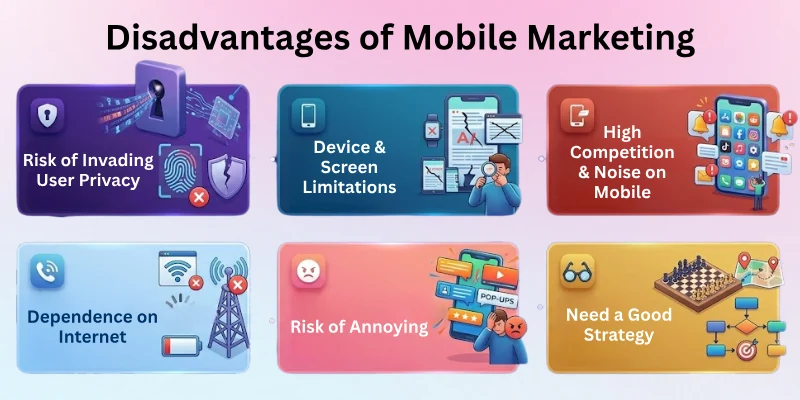
Knowing these disadvantages helps you plan campaigns better and avoid common mistakes.
- Risk of Invading User Privacy
- Device and Screen Limitations
- High Competition and Noise on Mobile
- Dependence on Internet and User Device Quality
- Risk of Annoying or Overwhelming Users
- Need a Good Strategy
Let’s see the mobile marketing disadvantages.
1. Risk of Invading User Privacy
Mobile marketing relies on collecting user data like location, browsing habits, and app usage. Some users feel uncomfortable knowing businesses track their behaviour. This can create negative feelings about the brand.
If businesses do not handle personal information properly, users may stop interacting with ads or even report the brand. Respecting privacy is essential to maintain trust and encourage long-term engagement.
- Users may feel monitored or tracked
- Mishandling data can harm brand reputation
- Blocking or ignoring ads is common if privacy feels violated
- Brands must use data responsibly
Warning: Poor data handling can reduce customer trust quickly.
2. Device and Screen Limitations
Phones come in various sizes, resolutions, and systems, which makes designing mobile content challenging. A visually appealing ad on one device might display poorly on another.
Businesses must ensure that images, text, and buttons work well on different screens. Failure to do so can frustrate users, cause them to leave, and lower conversion rates.
- Different screens require adaptable designs
- Poorly formatted ads frustrate users
- Users may leave if the content is hard to interact with
- Test ads across multiple devices
Insight: Always test ads on multiple devices before launching.
3. High Competition and Noise on Mobile
Mobile users receive hundreds of messages, notifications, and ads every day. With so much content, it is hard for a single campaign to capture attention.
Businesses must create unique, engaging, and relevant content to compete. Otherwise, even well-targeted ads may be ignored or skipped, reducing their effectiveness.
- Users are exposed to many ads daily
- Standing out requires creative content
- Poor engagement is common in crowded spaces
- Relevance and clarity increase success
Fact: Only clear and creative ads grab attention.
4. Dependence on Internet and User Device Quality
Mobile marketing campaigns depend on a fast and stable internet connection. Slow networks or older devices may prevent ads from loading correctly, reducing reach.
Areas with limited connectivity or users with low-end phones may experience less engagement. Businesses need lightweight and optimized campaigns to ensure smooth delivery and interaction.
- Ads may fail with poor internet
- Older devices can limit display and functionality
- Reduced reach in areas with weak connectivity
- Optimize content for speed and compatibility
Note: Lightweight content works better for all users.
5. Risk of Annoying or Overwhelming Users
Frequent messages, popups, and notifications can irritate users. Overusing these tools can push users to block communication or uninstall apps.
Excessive marketing can harm the brand’s image and reduce loyalty. Businesses must carefully manage the number and type of communications to maintain positive user experiences.
- Too many notifications can frustrate users
- Overuse may cause users to block ads
- Negative user experience damages brand loyalty
- Control frequency and relevance carefully
Warning: Over-messaging reduces brand loyalty.
6. Need a Good Strategy
Mobile campaigns require precise planning, targeting, and timing. Without a strategy, ads may fail to reach the right audience or generate meaningful results.
Mistakes like improper ad placement, slow-loading content, or poor messaging can waste budget and lower ROI. Continuous monitoring and adjustments are essential for success.
- Proper targeting ensures efficient spending
- Poorly designed ads can waste money
- Continuous monitoring improves results
- Test campaigns before full rollout
Tip: Test and optimize campaigns regularly for better results.
How to Use Mobile Marketing Correctly (Tips)
To get the best results from mobile marketing, follow these important tips. They help you reach the right audience without annoying users or wasting resources:
- Simple Ads: Use short text, clear images, and big buttons so users can easily read and interact with your ads.
- Respect Privacy: Always ask for permission before sending messages or collecting data to build trust.
- Right Audience: Use demographic, location, or interest data wisely to reach the people most likely to engage.
- Test and Track: Monitor clicks, views, and conversions. Test different messages and formats to find what works best.
- Avoid Spam: Don’t overwhelm users with too many messages or pop-ups. Focus on relevant and friendly content.
Final Words
This article covered the main advantages and disadvantages of mobile marketing. While mobile marketing is cost-effective, fast, and allows you to reach the right people, it can also backfire if ads are annoying or poorly designed.
Personally, I recommend focusing on quality over quantity: send clear, helpful messages and avoid overwhelming your audience. Pay attention to the user experience, and always test your campaigns before launching them widely.
If you follow these tips, you can use mobile marketing to build stronger connections with your customers and improve your business results.
Don’t wait, start making smarter campaigns today!
FAQs: Benefits and Drawbacks of Mobile Marketing
After reading this guide, you might have questions about the merits and demerits of mobile marketing. Here are clear and simple answers:
Mobile advertising has some clear drawbacks that you should keep in mind:
- Negative experiences spread fast and can hurt your brand.
- Ads reach users instantly, so bad ads can cause quick damage.
- Businesses may make wrong assumptions about users.
- Big data shows actions but does not show the user’s real intent.
Yes, mobile advertising is effective. It uses smartphones and tablets to reach the right audience with messages made just for them. Mobile ads are cheaper than traditional ads, reach people in real time, and are easy to access wherever the audience is.
The main purpose of mobile marketing is to reach the right customers and connect with them directly. It allows businesses to send messages or ads that are useful and relevant. Mobile marketing is fast and easy, so you can reach people anytime and anywhere.
Mobile advertisements offer many benefits for businesses, making it easier to reach the right audience:
- Saves money compared to traditional advertising.
- Targets specific audiences easily.
- Gives access to individual user profiles.
- Allows creating ads quickly and easily.
Mobile marketing is faster and often cheaper than traditional methods like TV or print ads. It can reach people directly on their devices. However, both can work together depending on the business goal.
Ask permission before sending messages or ads. Avoid sending too many ads and respect user privacy. Focus on giving value, like special offers or helpful information.




- Be Respectful
- Stay Relevant
- Stay Positive
- True Feedback
- Encourage Discussion
- Avoid Spamming
- No Fake News
- Don't Copy-Paste
- No Personal Attacks
- Be Respectful
- Stay Relevant
- Stay Positive
- True Feedback
- Encourage Discussion
- Avoid Spamming
- No Fake News
- Don't Copy-Paste
- No Personal Attacks
